
Yes. Slip and fall cases are harder to win in Texas than in a lot of other states, and the reason is narrow and specific. In most of these cases you have to prove how long the hazard was on the floor before you stepped in it. Not that it was there. Not that it hurt you. How long it sat there before you walked up.
That one requirement ends more Texas slip and fall claims than anything else, and the Texas Supreme Court tightened its grip on it again in April 2026. I am Jeff Todd, a personal injury attorney in Houston. I have practiced law for about 25 years, and from 2003 to 2007 I did insurance defense work in Galveston, representing the companies that now sit across the table in these cases. When a defense adjuster opens a fall file, they go to the same three things every time: how long the hazard was there, what the inspection records show, and what the video shows. That order has not changed in two decades.
Hard is not the same as hopeless. These cases get won on evidence that exists in the first days and weeks after a fall and quietly disappears if nobody demands it.
The short version:
- Texas requires proof that the property owner knew, or should have known, about the hazard. “Should have known” requires evidence of how long it was there.
- If an employee actually saw the spill before you fell, the duration problem goes away.
- Surveillance video, sweep logs, and witness testimony about timing are what turn a losing file into a winnable one, but only when they speak to when the hazard appeared.
- Retail video is commonly overwritten in 30 to 90 days. That clock starts the day you fall.
- You generally have two years to file. If the property belongs to a government entity, you may have as little as six months to give notice.
Why Texas slip and fall cases are harder than people expect
Texas does not make a store responsible just because you got hurt there. A property owner is not an insurer of your safety. To hold a store responsible, you have to show it had knowledge of the dangerous condition, and there are only two flavors of that.
Actual knowledge means someone who worked there knew. An employee saw the spill. A customer reported it. A manager walked past it.
Constructive knowledge means nobody admits to seeing it, but the hazard sat there long enough that a reasonable store would have found it during normal inspections. This is where nearly every case lives, because spills rarely come with witnesses.
Texas courts weigh three things in deciding whether an owner should have known: how long the condition existed, how close the owner or an employee was to it, and how conspicuous the condition was. Duration is the one that decides cases. Without it, the other two do not get you anywhere.
The catch is what Texas demands as proof of duration. Under Wal-Mart Stores, Inc. v. Reece, 81 S.W.3d 812 (Tex. 2002), you have to show it is more likely than not that the condition existed long enough to give the owner a reasonable chance to discover it. Possibly long enough is not enough. In Wal-Mart Stores, Inc. v. Gonzalez, 968 S.W.2d 934 (Tex. 1998), a plaintiff pointed to dirt and cart tracks through spilled macaroni salad, plus testimony that it looked like it had been sitting there a while. The court called that no evidence at all.
Other states have softened this. Under the mode of operation rule, which traces back to Jasko v. F.W. Woolworth Co., 494 P.2d 839 (Colo. 1972), an injured person does not have to prove notice when the way a business operates makes spills continuous and foreseeable. Texas has not adopted it, and the supreme court has repeatedly turned down requests to relax the burden of proof in fall cases. That is the doctrinal difference people are describing when they say Texas is tough on these claims.
What you have to prove in a Texas slip and fall case
For a customer or shopper, which the law calls an invitee, there are four elements:
- The owner or occupier had actual or constructive knowledge of a condition on the property.
- The condition posed an unreasonable risk of harm.
- The owner failed to use reasonable care to reduce or eliminate the risk.
- That failure caused your injury.
Miss any one of them and the case ends, often before a jury ever hears it. In practice, element one is where cases die.
Does it matter if an employee saw the spill before I fell?
It matters enormously. If the store had actual knowledge, the whole duration analysis never starts. A customer who reported the spill at the register, an employee who walked past it and said something, an incident report noting a known leak in that exact spot. Any one of those changes the character of the case.
This is the first question I ask on the phone, and it is why I want to know who you talked to at the store and whether anyone else was standing nearby. People routinely tell me the weakest fact first and bury the strongest one three minutes into the conversation.
What H-E-B, LP v. Peterson means for Texas slip and fall claims
On April 10, 2026, the Texas Supreme Court decided H-E-B, LP v. Peterson, No. 24-0310, and it is the case defense lawyers in Texas now reach for in a fall file.
The facts are ordinary, which is exactly why the ruling matters. A shopper slipped on a clear liquid puddle in a toy aisle and saw water dripping from a rafter above it. It had rained earlier that day, and the store had a documented history of roof leaks from a remodeling project. Video showed no employee had walked that aisle in the two hours before she fell. She testified she had no idea how long the puddle had been there.
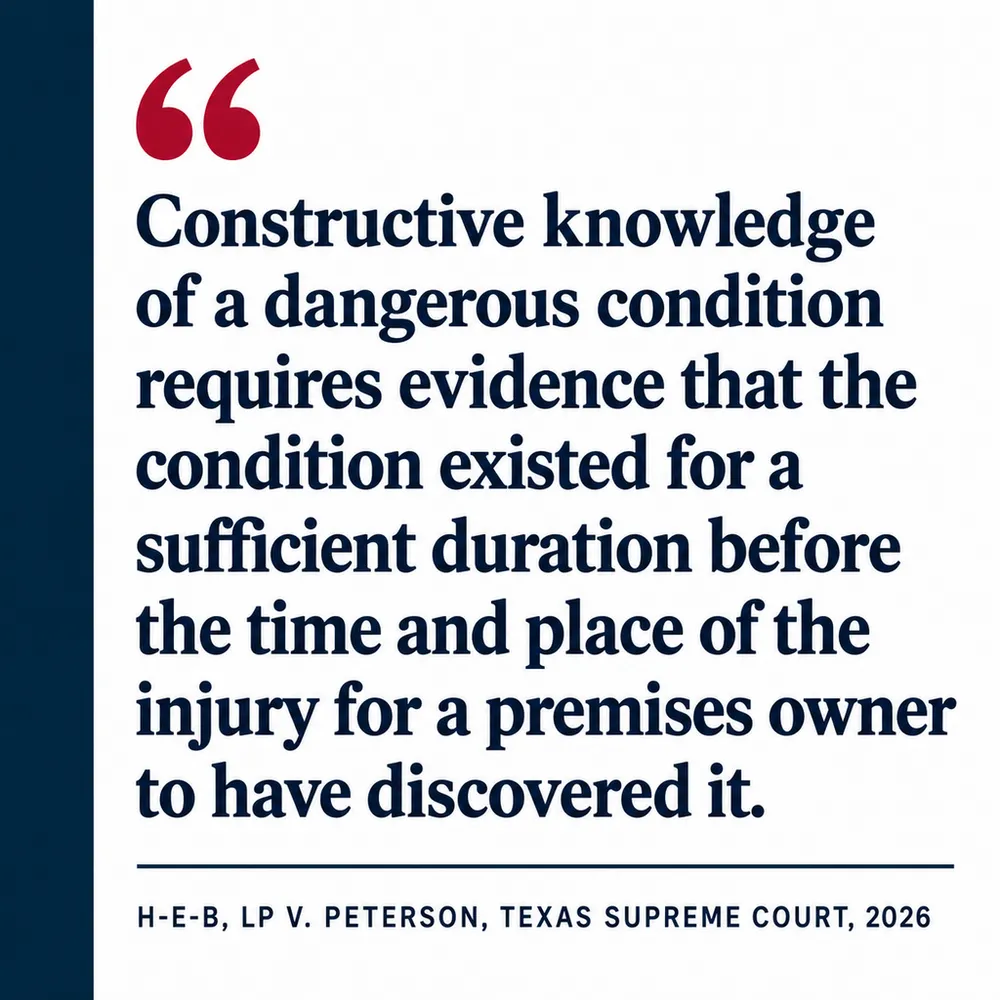
The court reinstated summary judgment for the store. The holding, in plain terms: constructive knowledge requires evidence that the condition existed “for a sufficient duration” before the injury for the owner to have discovered it, and that record had nothing on how long the puddle was on the floor.
Four pieces of the opinion are worth understanding, because they are the arguments that will be used against you.
Cause is not duration. Rain earlier in the day speaks to where the water might have come from. It says nothing about when it landed on that floor. Same for the rafter drip. Same for the size of the puddle. Every one of those facts felt persuasive, and none of them told a jury how long the hazard sat there.
A gap in inspections is not duration either. Peterson had video showing no employee walked that aisle for two hours. That still was not evidence of how long the puddle was on the floor, because nothing tied the gap to the moment the water appeared. This is the part people get wrong most often. An employee’s proximity to a hazard, with no evidence of how long the hazard was there, does not establish notice.
Prior problems elsewhere in the building do not carry over. Repaired leaks in other parts of the store were not probative of the store’s knowledge of a puddle on the toy aisle. For a leak to matter, it has to be in the vicinity of the liquid you slipped on. Knowledge gets measured at the time and place the injury happened.
A store’s own safety policy does not raise its legal duty. If a company handbook says employees must keep floors hazard free, that does not hold the company to a higher standard than the law requires. It is not the gotcha people assume it is.
Which evidence actually proves how long a hazard was there?
Texas courts have been fairly clear about what counts and what does not.
| Evidence | What it actually shows | Does it establish duration? |
|---|---|---|
| Video of employees passing the hazard repeatedly in the minutes before the fall | The hazard was present and visible over a measurable stretch of time | Yes. Held to be some evidence of constructive knowledge in Brookshire Brothers v. Aldridge |
| Witness who saw the spill before you did | Direct testimony about timing | Yes |
| Sweep or inspection log showing a long gap since the last check | The area went uninspected | Not by itself. A two-hour gap was rejected in Peterson. It helps only alongside evidence of when the hazard formed |
| Employee standing near the hazard, with no timeline attached | Proximity only | No. Rejected in Reece |
| Rain earlier in the day, or a drip from above | A possible cause | No. Rejected in Peterson |
| Size of the puddle | A possible cause | No. Rejected in Peterson |
| Dirt or cart tracks through the substance | That something passed through it | No. Rejected in Gonzalez |
| Prior repairs elsewhere in the building | Maintenance history | No. Rejected in Peterson |
| The store’s internal cleaning policy | The company’s own standard | No |
Notice what the “yes” rows have in common. Both are records or witnesses the business controls or knows about, and neither will be handed over voluntarily. That is the whole ballgame.
How Texas slip and fall cases get won
The clearest example in Texas law is Brookshire Brothers, Ltd. v. Aldridge, 438 S.W.3d 9 (Tex. 2014). Video showed employees repeatedly passing a large grease spill in the five minutes before the customer slipped. The Texas Supreme Court pointed to that footage in Peterson as the contrast, because it spoke to how long the hazard was present rather than where it came from.
That case usually gets quoted as a win story, and that is only half of it. The jury awarded Aldridge just over a million dollars. The supreme court then reversed and sent the case back for a new trial, holding the trial court should not have given the jury a spoliation instruction over the destroyed video. What Aldridge proves is that duration evidence can be legally sufficient to reach a jury.
Duration evidence gets you past summary judgment and in front of a jury. What happens after that depends on the injuries, the venue, and a dozen things nobody can promise you in advance. Every case is different, and no lawyer can guarantee you a result.
Why the first 30 days decide most of these cases
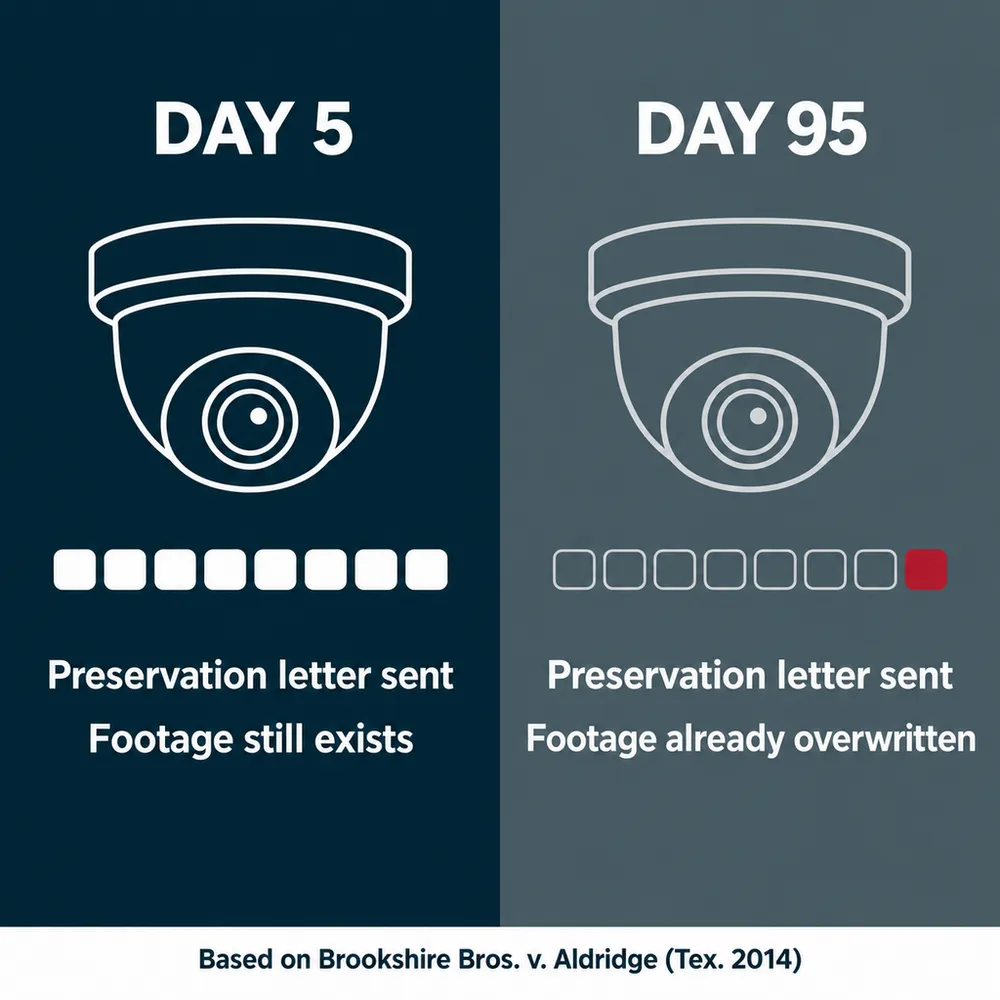
Aldridge also shows what happens when nobody moves fast. The store preserved eight minutes of footage around the fall, and the rest was deleted on the normal 30-day cycle, so when the lawyer asked for it about a year later, it was gone. That is not unusual. Commercial surveillance systems commonly hold footage for 30 to 90 days before overwriting it automatically, and smaller or older systems can be as short as a few days or weeks.
People assume you can punish a business for that. Usually you cannot. Under Brookshire Brothers, whether spoliation happened is a question the judge decides outside the jury’s hearing, and the harshest remedy generally requires intentional destruction. A duty to preserve only attaches once the business knows, or reasonably should know, that a claim is substantially likely, so routine overwriting before that point usually is not sanctionable at all.
Which is why a preservation letter, sent early, is often the single most consequential thing that happens in a slip and fall case. It converts the store’s routine deletion policy into a legal problem for the store. Sent on day 5, it can save the case. Sent on day 95, it only documents what has already been erased.
The same urgency applies to sweep and inspection logs, the records showing when an employee last checked or cleaned that area. They cut both ways. A long gap since the last documented sweep, paired with evidence of when the hazard appeared, supports the inference that it sat there long enough to be found. A recent, well-documented sweep helps the defense argue the spill happened moments before you did.
Does it matter whether you were a customer, a guest, or on private property?
Yes, and it changes the duty owed to you before any of the above even applies.
| Your status | Typical example | What the owner owes you |
|---|---|---|
| Invitee | A shopper, a customer, anyone there for the owner’s business benefit | Ordinary care, including a duty to inspect for hazards the owner does not yet know about |
| Licensee | A social guest, someone on the property with permission but not for business | A duty to warn of or fix dangers the owner actually knows about. No duty to inspect |
| Trespasser | Someone on the property without permission | Only a duty not to injure willfully, wantonly, or by gross negligence |
If you fell in a store, a restaurant, a hotel lobby, or a parking lot while shopping, you were almost certainly an invitee, which is the strongest position. The distinction becomes a live fight when you were somewhere after hours, in an employee-only area, or on a neighbor’s property.
Defenses that sink Texas slip and fall claims
Two come up constantly.
The hazard was open and obvious. Under Austin v. Kroger Texas, L.P., 465 S.W.3d 193 (Tex. 2015), a property owner generally owes no duty to warn about or protect against conditions that are open and obvious or already known to you. There are narrow exceptions, including situations where you had no reasonable choice but to encounter the hazard. If the spill was coned off, brightly marked, and you walked through it anyway, this defense is going to hurt.
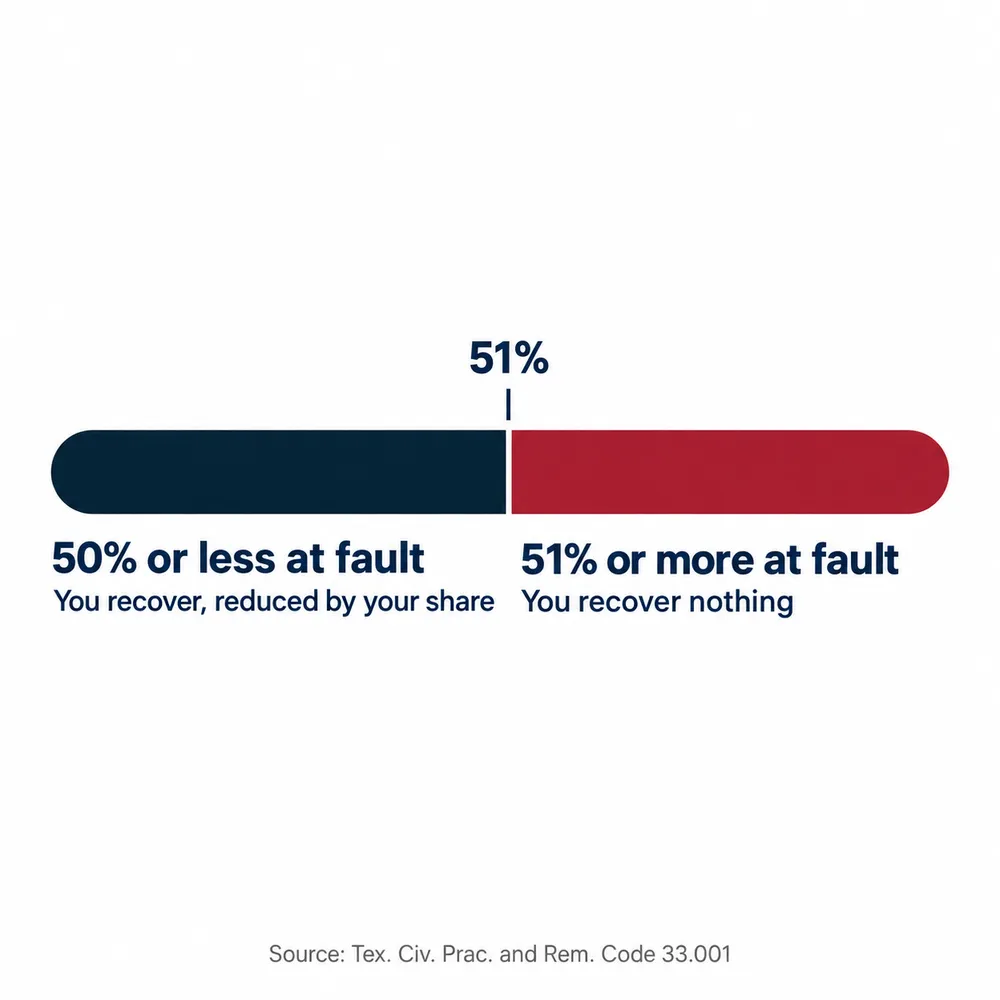
You were partly at fault. Texas uses proportionate responsibility under Chapter 33 of the Civil Practice and Remedies Code. If you are found more than 50% responsible, you recover nothing. At 50% or less, you recover, reduced by your share. Looking at your phone, wearing the wrong shoes, and ignoring a warning sign are all things the defense will put in front of a jury to move that percentage.
How long do you have to file a slip and fall claim in Texas?
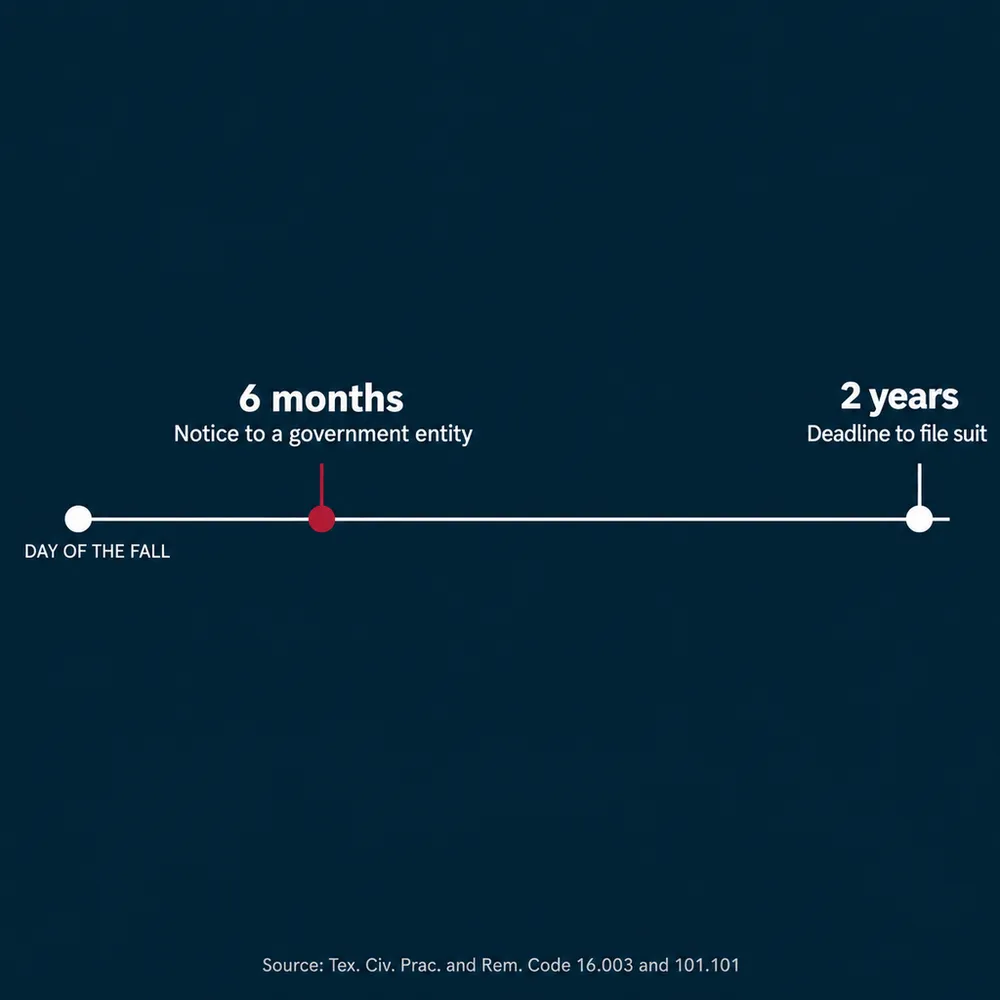
Two years from the date of the injury for most personal injury claims, under Section 16.003 of the Civil Practice and Remedies Code. Miss it and the claim is gone no matter how strong the evidence was.
Two years sounds generous. It is not, for the reason described above. The evidence that decides these cases is usually gone within 90 days.
What if I fell on government property?
Different rules, and they are worse for you in two ways.
Under Chapter 101, a governmental unit is entitled to notice of a claim no later than six months after the incident, and city charters and ordinances commonly impose deadlines that are much shorter. You have to check the specific entity’s rule, because they are not uniform.
On top of that, for an ordinary premises defect, a governmental unit generally owes you only the duty owed to a licensee rather than an invitee. In practical terms, you would need to show the entity actually knew about the hazard, not just that it should have found it.
A fall at a city building, a public hospital, a school, or a transit facility is a different animal from a fall at a grocery store, and the clock is the first thing to deal with.
Does the new Texas summary judgment rule change slip and fall cases?
Texas rewrote Rule 166a, the summary judgment rule, effective March 1, 2026. Deadlines now run from the date the motion is filed rather than from a hearing date. None of that changes premises law. The supreme court said as much in Peterson, noting that the revisions apart from the deadline changes are not intended to change the law and that courts should carry existing case law forward. Peterson itself was decided under the old version, and the new deadlines apply only to motions filed on or after March 1, 2026. The no-evidence motion that ended Peterson’s case is still fully available to every defendant.
The practical effect runs the other way. Filing-based deadlines leave less room to scramble for evidence after a motion lands, so the duration proof has to be gathered long before that point.
How often do slip and fall cases go to trial, and how often do plaintiffs win?
There is no good Texas-specific answer, and I would be careful with anyone who gives you one confidently.
The win-rate numbers that circulate on this topic come from the U.S. Bureau of Justice Statistics Civil Justice Survey of State Courts, whose most recent data year is 2005. In that survey, plaintiffs won about 52% of tort trials of every kind, but only about 38% of premises liability trials, and trials accounted for roughly 4% of all tort dispositions. Those figures are two decades old and national. They tell you that trials are rare and that premises cases were harder than most. They tell you nothing reliable about your odds in Harris County in 2026.
What is current is the injury data. The National Safety Council reports more than 10 million people were treated in emergency departments for fall-related injuries in 2024. Falls are common. Winnable fall cases are less common. Both things are true.
When a fall is not a case
I will say this plainly because most attorney websites will not.
Plenty of falls do not make a claim in Texas. If you slipped on something that hit the floor 45 seconds before you got there, the store did nothing wrong under the law, and no amount of documentation changes that. If the hazard was obvious and marked, that is a problem. If you cannot identify what you slipped on at all, which happens more often than you would think, there is usually nothing to build on.
When someone calls me with a fall that does not work, I tell them on the phone, and it does not take long. I do not need to talk anyone into hiring a lawyer, and I do not want you spending two years on a claim that was never going anywhere.
Premises liability and slip and fall work are the core of my practice, and I take a hard look at cases other Houston firms turn down. Being turned down once does not mean the evidence was not there. Sometimes it means nobody went looking for it while it still existed.
What to do after a fall at a Texas business
The steps below exist for one purpose: to lock down proof of how long the hazard was there before it disappears.
- Report it before you leave and ask for an incident report. Get the manager’s name. Ask for a copy. That report often fixes the date, time, and location, which matters later when the store’s version gets fuzzy.
- Photograph the hazard itself, not just the aftermath. Get the substance, the surrounding floor, any tracks through it, any warning signs present or absent, and a wide shot showing where the nearest employee station was.
- Get names and numbers of witnesses. Other shoppers who noticed the spill earlier are duration evidence the store does not control.
- Note where the cameras are. Look up. Cameras in the ceiling near your fall are the footage someone needs to demand in writing, quickly.
- Keep the shoes and clothes you were wearing, unwashed. The defense will raise your footwear. Preserve it.
- See a doctor promptly and keep going. Gaps in treatment are one of the most common ways these claims fall apart. Insurers read a gap as proof you were not really hurt.
- Do not give a recorded statement to the store’s insurer. Those calls are designed to pin down a version of events before you know what happened. You are not obligated to give one.
- Talk to an attorney inside the first few weeks, not the first few months. A preservation letter has to go out while the video still exists.
What a slip and fall attorney costs in Houston
Nothing up front. I work on contingency, which means my fee comes out of the recovery and there is no fee unless I win the case. My fee is 33% if the case settles before a lawsuit is filed, 40% if I file suit, and 45% if the case goes to appeal.
Case expenses are separate from the fee. These are the out-of-pocket costs of building the case, like filing fees, records charges, and depositions. Who pays them, and whether they come out before or after the fee is calculated, is spelled out in the written fee agreement, and I go through that with you at the free consultation before you sign anything. I have written more about what a personal injury lawyer costs in Houston if you want the longer version.
Talk to me about your fall
If you fell at a store, a restaurant, or a commercial property in the Houston area, the most useful thing you can do this week is find out whether the evidence still exists. That question has an expiration date on it.
I handle premises cases across greater Houston, including slip and fall claims in the Galveston area. I will look at what happened and tell you straight whether you have something worth pursuing, including when the answer is no. When you hire me, you get me. You will have my cell number, and you will talk to me rather than a chain of people you never meet. The consultation is free and the phone is answered by a real person at any hour. Contact me here or call (832) 243-4953.
This article is general information about Texas premises liability law, not legal advice about your situation, and reading it does not create an attorney-client relationship. Every case is different. See the full disclaimer.