
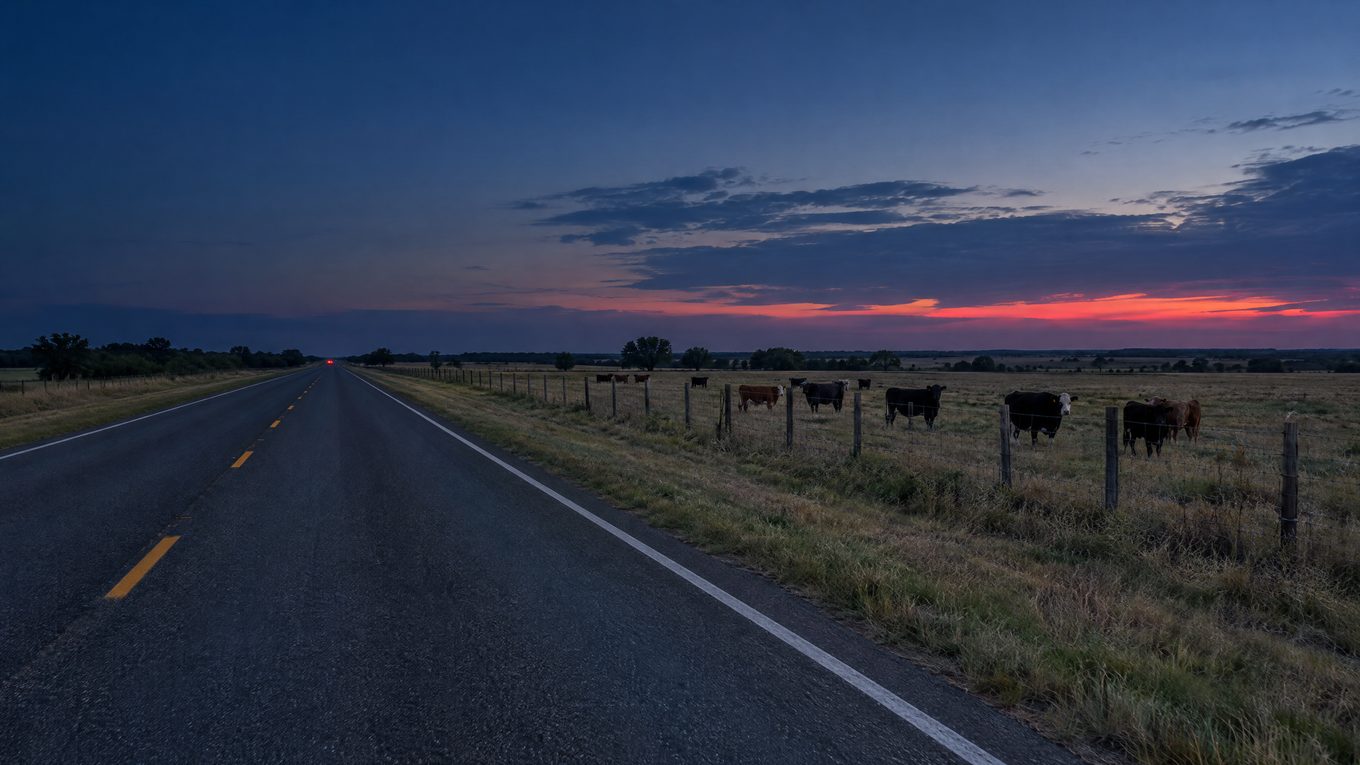
If you hit a cow on a U.S. or state highway in Texas, you very likely don’t owe the owner anything for the animal. Your own auto policy is usually what pays for the crash. Comprehensive coverage pays to fix your car. Personal injury protection pays medical bills for you and your passengers. Every Texas auto policy includes it unless you turned it down in writing (TDI consumer guide), so you probably have it. The cow’s owner has to pay only if you can prove the owner broke a Texas law about keeping livestock off the road.
I’m Jeff Todd, a Houston personal injury attorney with about 25 years of legal experience. I spent the early part of my career defending insurance companies, so I know how an insurer looks at a claim from the inside.
Who is liable when you hit a cow in Texas?
The cow’s owner is liable for your crash only if a Texas law required the owner to keep the animal off that road and the owner broke that law. Texas is free range by default. That means that unless a specific law says otherwise, a livestock owner doesn’t have to keep animals off the road at all. A county or area where that default still applies is called open range. Tiffany Dowell Lashmet, an agricultural law professor with Texas A&M AgriLife Extension, told Texas Standard that in an open-range county, “there is no legal duty on that livestock owner to fence those cattle in.”
Which law applies to the owner depends on the kind of road you were on.
Does the type of road change who is liable?
The type of road decides which law the owner had to follow. Texas has one state law for U.S. and state highways (Agriculture Code 143.102). That law doesn’t cover numbered farm-to-market roads (Agriculture Code 143.101). Farm-to-market roads, county roads and other local roads fall under a local stock law if the area has one, and under the free-range default if it doesn’t. The road signs or mile markers where you crashed tell you which kind of road it was.
| Where the crash happened | Which law applies | What you’d have to prove about the owner |
|---|---|---|
| U.S. or state highway | The state highway law | The owner knowingly let the animal roam loose on the highway. |
| Any other road, in an area with a stock law | The local stock law | The owner allowed the animal to roam loose. The stock law leaves out the word “knowingly,” so this is easier to prove than the highway rule. |
| Any other road, in an open-range area | No law requires the owner to keep animals off the road | Usually there’s no claim. |
The highway law covers horses, mules, donkeys, cattle, hogs, sheep and goats. On a U.S. or state highway, it is the only rule, even in a county that has a stock law. The Supreme Court of Texas decided that in 2020 in Pruski v. Garcia, a case about a bull on a state highway in a county with a stock law. The court held that the highway law “provided the exclusive standard for the livestock owner’s liability,” so the driver couldn’t rely on the county’s stock law. I go through the case in more detail on my cattle and livestock accident page.
Areas with a stock law are often called closed range. Even there, Lashmet said, a stock law “doesn’t mean automatic liability for the livestock owner.” You still have to prove the owner let the animal roam loose.
Is my county open range, and how do I find out?
The county’s own records are the only reliable way to know whether the road where you crashed is open range. Lashmet estimates that “over half of the counties in Texas do have a stock law.” A stock law can cover a whole county or only part of one, sometimes “precinct by precinct.”
To check for the place where you crashed:
- Contact the county clerk in the county where the crash happened.
- Ask whether the county ever held a stock law election covering that area. Stock laws are adopted by a local vote. The result is recorded in the minutes of the commissioners court (Agriculture Code 143.073), and you can ask the county clerk for those minutes.
- Ask which animals the stock law covers. A law about cattle may not cover horses or hogs.
Hockley County Sheriff Ray Scifres described the same search to KCBD: “You have to go through the county’s registers to see, did they hold an election.”
Do I have to pay the owner for the cow?
You don’t have to pay the owner for a cow you hit on a U.S. or state highway unless you were grossly negligent or hit the animal on purpose. Texas law protects drivers from having to pay for a loose animal they hit on a highway (Agriculture Code 143.103). Gross negligence means far more than an ordinary driving mistake.
That protection is part of the same highway law, so it covers only U.S. and state highways. On a farm-to-market or county road, it may not apply. If the owner asks you to pay for an animal you hit on one of those roads, don’t agree to anything until you’ve talked with a lawyer.
Who pays for my car and medical bills after hitting a cow?
Your own auto policy usually pays for both your car and your medical bills after you hit a cow. Insurance treats hitting an animal as a comprehensive claim, not a collision claim. The Texas Department of Insurance answers the question of whether your policy covers hitting an animal with “Yes, if you have comprehensive coverage” (TDI auto insurance FAQ). Your injuries are covered by personal injury protection, or PIP, which pays no matter who was at fault (Texas Insurance Code 1952.155).
| Where the money comes from | What it pays for after hitting a cow |
|---|---|
| Your comprehensive coverage | Damage to your car. You pay your deductible. |
| Your personal injury protection (PIP) | Medical bills for you and your passengers, plus lost wages and other nonmedical costs |
| Your health insurance | Your medical care, under the terms of your plan |
| Liability-only coverage | Nothing for your own car |
| The animal’s owner | What your own coverage didn’t pay, but only if the owner is legally responsible |
Can my insurance company drop me for this claim?
Your insurance company can’t drop you for filing a claim for hitting an animal, but it may raise your rate when you renew, according to the TDI auto insurance FAQ.
What does it mean that the owner “knowingly” let the animal out?
On a U.S. or state highway, “knowingly” means the owner was actually aware, not just that the owner should have known. In Pruski, the Supreme Court of Texas took the meaning of the word from the Texas Penal Code. In everyday terms, the owner had to know the animal was loose on the highway, or know that what they were doing was reasonably certain to put it there.
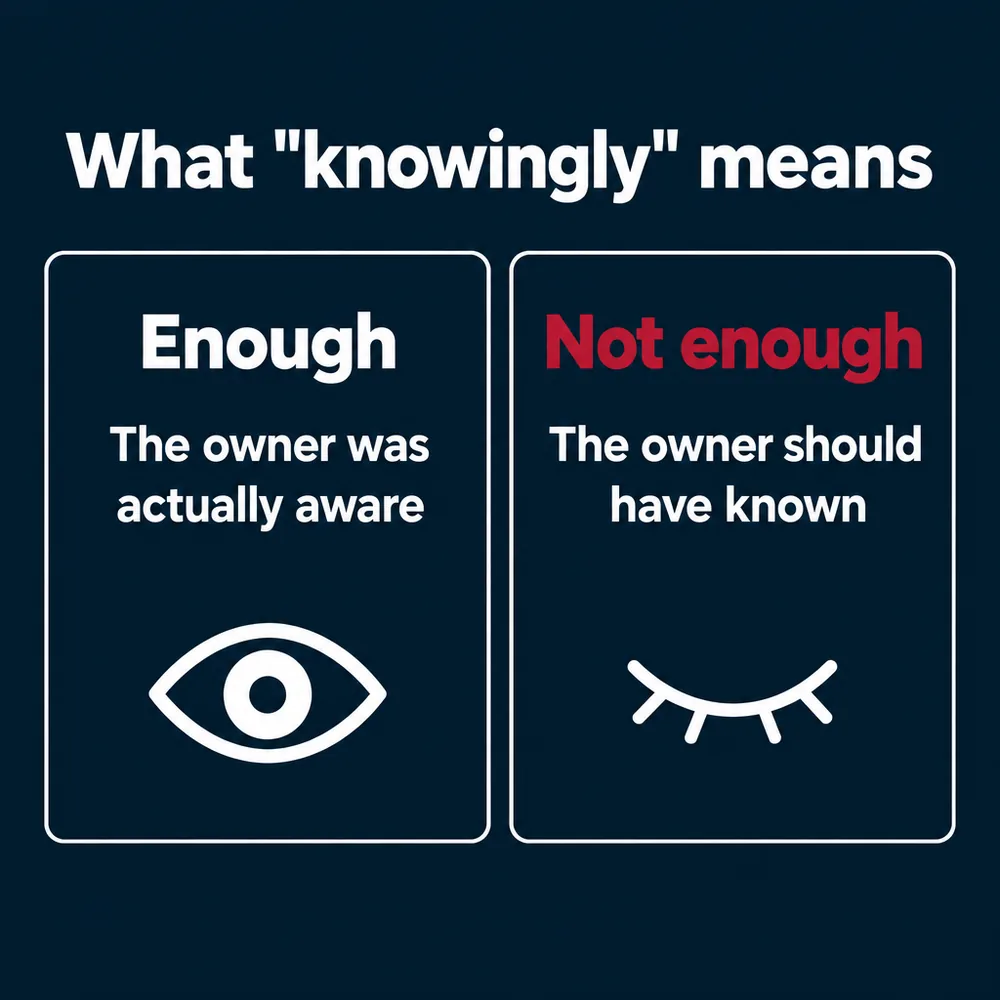
The highway law says an owner may not “knowingly permit” an animal to roam loose. A later appeals court, quoting Pruski, said “permit” means the owner was aware of the escape or went along with it, as opposed to simply overlooking it or being careless (Texas A&M AgriLife). So a weak fence, a gate the owner didn’t know was open or an owner who should have checked more often is usually not enough. Another Texas appeals court held that an animal escaping onto a highway doesn’t, by itself, show that the owner was at fault (Texas A&M AgriLife).
What facts have courts said weren’t enough?
In two recent Texas cases, the driver lost because the evidence didn’t show that the owner knew.
Mullins v. McWhirter. A motorcyclist hit a cow on a highway. A jury decided the owner had knowingly let the cow onto the highway. The appeals court in Eastland overturned that decision and ruled for the owner. These facts weren’t enough:
- The owner lived about 200 miles away and had last been to the property a week before the crash.
- The cow had gotten out more than once before, but the court found those earlier escapes didn’t show the owner knew this one would happen.
- A witness who inspected the fence 10 months after the crash couldn’t say how the cow got out.
Arraby Properties v. Brown. The trial court ruled for the driver. The First Court of Appeals in Houston overturned that ruling and decided for the owner. The court found too little evidence that the owner knowingly let the cow roam. These facts weren’t enough:
- The owner admitted the cow got out.
- The owner had no plan for what to do if an animal escaped.
- The people caring for the property couldn’t keep the fences maintained.
- Even so, no one showed the fence was broken when the cow got out.
A claim against the owner depends on evidence of what the owner knew before your crash. When I look at one of these cases, I want to know whether anyone had told the owner the animals were out, how long the animal had been on the road, and whether the owner knew a fence or gate was down and left it that way. That evidence goes away fast. A fence can be repaired in an afternoon, and people forget what they saw.
How do I find out who owns the cow?
The sheriff’s office and the county clerk are the two places to find out who owns the cow.
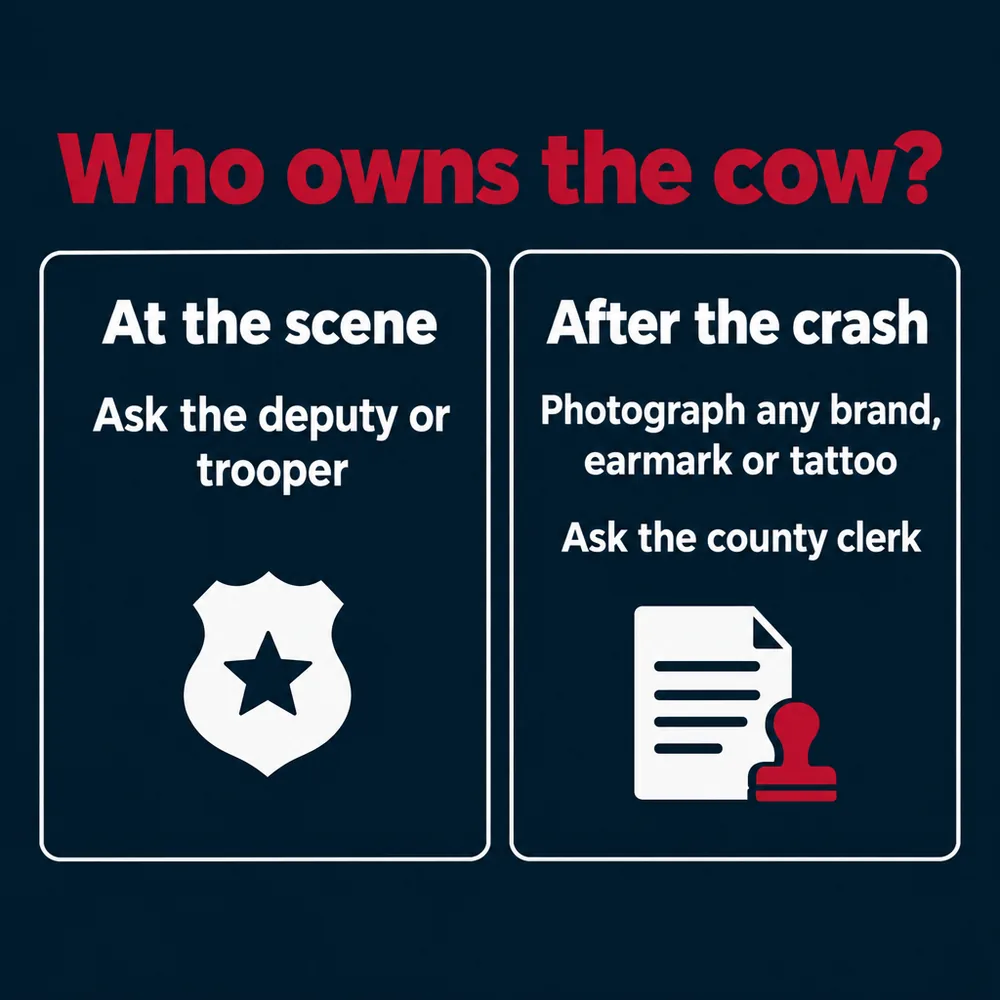
- Ask the deputy or trooper at the scene. The person who owns or manages the land where a stray animal turns up has to report it to the county sheriff (Agriculture Code 142.003). That report isn’t your job. The sheriff then contacts the owner, if the owner is known, so the sheriff’s office may already know whose animals these are.
- Photograph any brand, earmark or tattoo, and ask the county clerk about it. An earmark is a notch or cut in the animal’s ear. Livestock owners record brands, earmarks and tattoos with the county clerk in the county where the animals are kept (Agriculture Code 144.041), so the clerk’s records can show whose mark it is.
- Don’t assume the landowner is the owner. The duty to keep an animal off the highway falls on whoever owns the animal or is in charge of it. In a 2001 case, a Houston appeals court held that a landowner who had leased out the land wasn’t responsible.
What should I do after hitting a cow?
After hitting a cow, get to safety, call 911 and collect the evidence about the animal and the road before it disappears.
- Get to safety. If you can, move out of traffic and turn on your hazard lights. Stay away from the animal.
- Call 911. Texas law requires you to report a crash to the police, the sheriff or the Department of Public Safety right away when someone is hurt or killed or a vehicle can’t be driven safely (Transportation Code 550.026). The call also gets the animal off the road before someone else hits it.
- Take photos. Photograph the animal, any brand or ear tag, your car, the road, nearby road signs or mile markers, and any fence or gate you can see from the road.
- Get names. Write down the names of the officer, any witnesses and anyone who says the animal is theirs.
- Don’t agree to pay for the animal or say the crash was your fault. Be polite to the owner and get their contact information. Who pays for what can wait until you know which law applies to that road.
- Get the crash report. If an officer wrote up the crash, you can request the report through my Texas crash report page and I’ll get it for you. You can also buy it online from TxDOT. A regular copy costs $6.
- Report the claim to your insurance company. Ask about your comprehensive coverage for the car and your PIP coverage for medical bills.
- See a doctor if you’re hurt at all. Then talk to a lawyer before the evidence about the owner disappears.
What if I was hurt, or a family member was killed?
If you were hurt, your own PIP coverage and health insurance can pay your medical bills without waiting on the owner. A claim against the owner is how you would recover what your own coverage doesn’t pay. That claim depends on the road rules and on what the owner knew, so the evidence needs to be gathered quickly.
If you lost a family member in one of these crashes, I’m sorry. Your family may have a claim against the owner, and it depends on the same two things: the road rules and what the owner knew. You’ll find more on my wrongful death page.
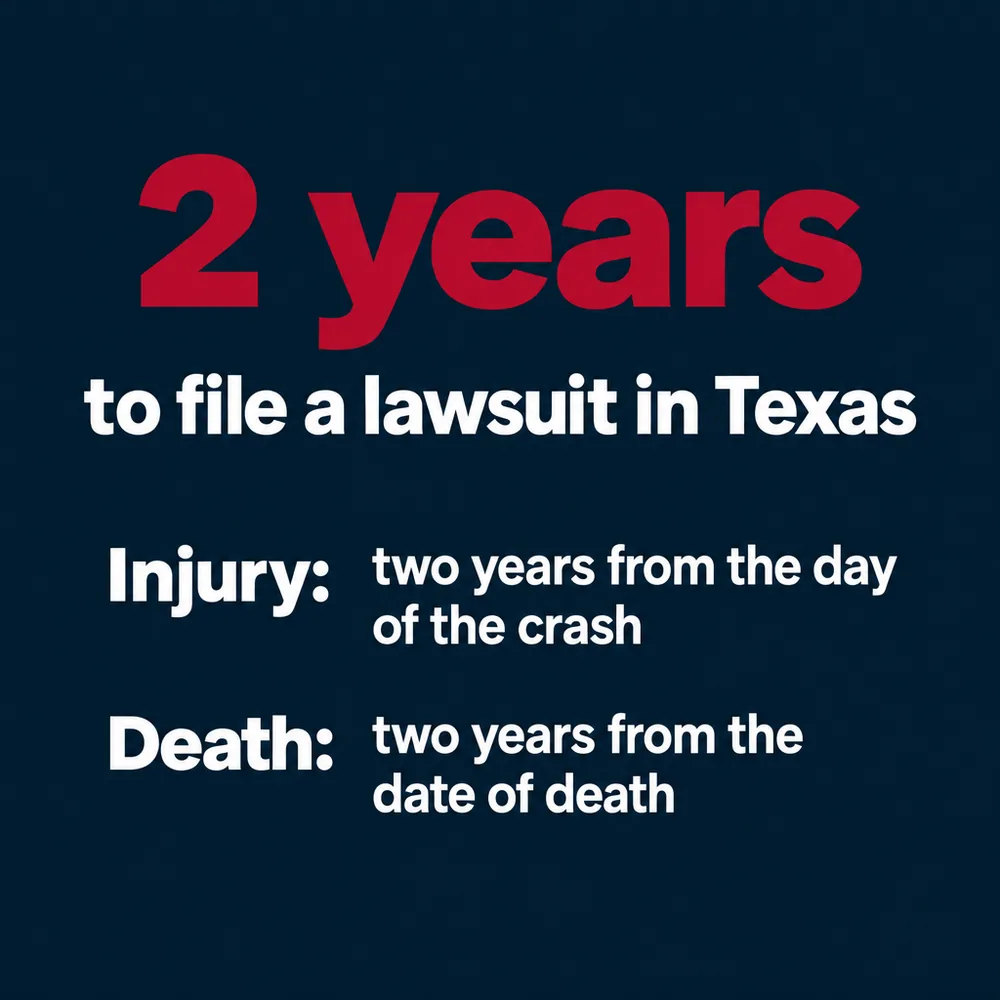
Texas gives you two years to file a lawsuit (Civil Practice and Remedies Code 16.003):
- For an injury, two years from the day the claim arises, which is generally the day of the crash.
- For a death, two years from the date of death.
Talk with me about your livestock crash
If you or someone in your family was hurt in a crash with a cow, horse or other livestock, I’d like to hear what happened. The consultation is free, and a live person answers my phone 24 hours a day, 7 days a week. I work on contingency, which means my fee is a percentage of what I recover for you, and there’s no fee unless I win. The fee is 33% if your case settles before a lawsuit is filed, 40% if a lawsuit is filed and 45% on appeal. You can read more about how my fees work. When you hire me, you get me, not a handoff to someone else. Contact me here and we’ll start with what you know about the owner and the road.
This article is general information about Texas livestock collision law, not legal advice about your situation, and reading it does not create an attorney-client relationship. Every case is different. See the full disclaimer.