

Choose a Houston personal injury lawyer on four things you can verify before you sign: who will personally handle your file, whether that lawyer handles your specific type of case, whether they have tried cases in front of a jury, and exactly what the fee agreement says about percentages and expenses. Those four change how a case gets worked and what it ends up being worth. Most of the rest of what you’ll read on this topic is generic advice that would apply to hiring anyone.
I’m Jeff Todd. I’ve practiced law for more than 25 years, licensed in Texas since 2000, and I spent the first part of my career on the other side of these cases, defending insurance companies, before I started representing injured people here in Houston. What follows is how I’d tell a friend to choose, including the parts that don’t help me. Some people don’t need a lawyer at all. And being turned down by two firms says less about your case than you probably think.
Read the deadlines section first. Some Houston claims can be lost in 90 days, not two years.
The short version of how to choose a Houston personal injury lawyer
- Texas gives you two years for most injury claims. A claim against a city or state entity can require written notice in six months, and the City of Houston charter cuts that to 90 days.
- Ask who physically handles your file, then listen for a name instead of a department.
- On fees, the percentage matters less than two things almost nobody asks about: when the percentage steps up, and whether expenses come out before or after the fee is calculated.
- A firm turning your case down reflects that firm’s read of the evidence plus its own economics and caseload. No court has weighed in.
The statute of limitations, and the shorter deadlines that catch people
Most Texas personal injury claims have a two-year statute of limitations. Under Texas Civil Practice and Remedies Code Section 16.003, suit must be brought no later than two years after the day the claim accrues. Death cases get the same two years, running from the date of death.
That’s the deadline everyone knows, and it’s the least urgent one on this list. If a government entity is involved, the clock is much shorter.
| Who you’re making a claim against | Deadline | What has to happen by then |
|---|---|---|
| A private person or business | 2 years from the injury | File suit |
| A Texas governmental unit | 6 months from the incident | Deliver written notice describing the injury, the time, the place, and the incident |
| The City of Houston | 90 days from the incident | Deliver verified written notice under the city charter |
Section 101.101 of the Texas Tort Claims Act sets the six-month notice requirement and expressly preserves shorter deadlines written into a city charter or ordinance. Houston has one. The City of Houston’s own claim page explains the 90-day requirement.
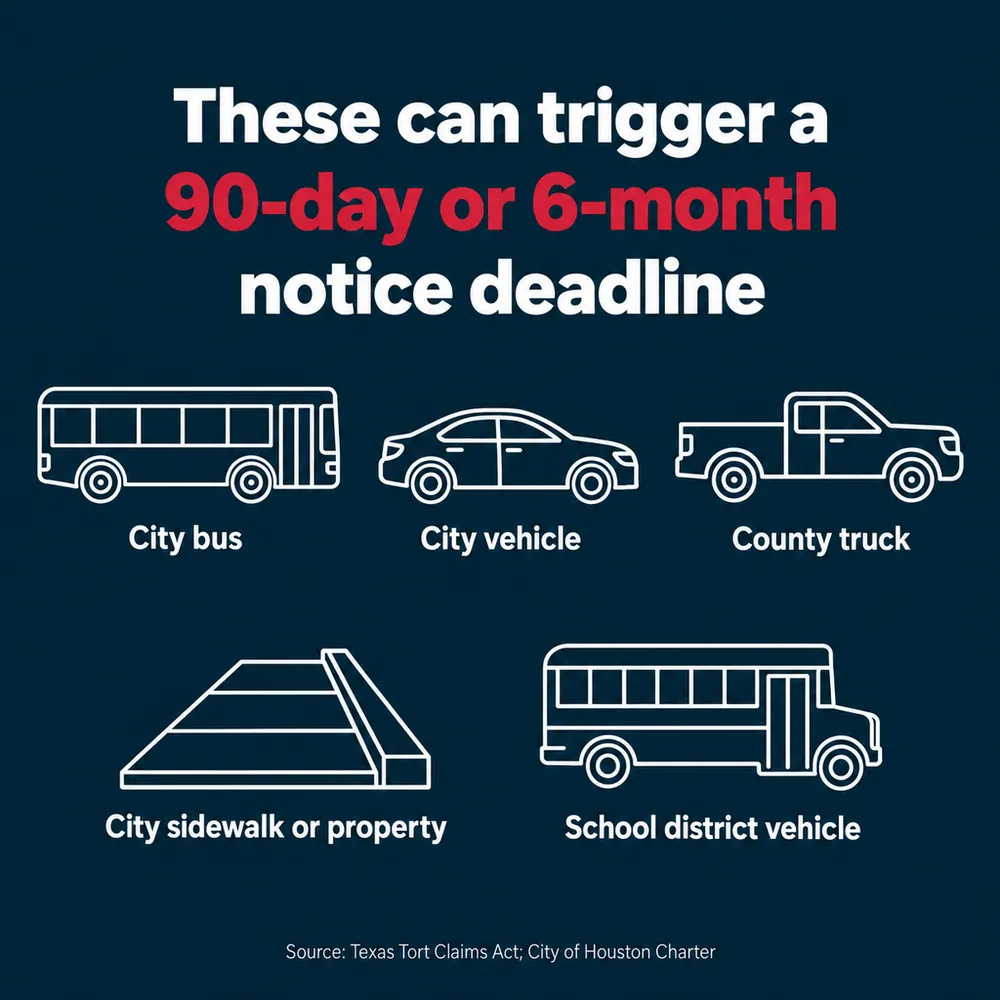
That comes up more often than people expect. Think about a METRO bus (the Metropolitan Transit Authority of Harris County), a city vehicle, a county truck, a fall on city property, or a school district vehicle, Houston ISD included. Any one of those can start a 90-day or six-month clock while you’re still sitting in physical therapy, assuming the two-year rule has you covered.
Section 16.001 of the same code treats a person under 18 or of unsound mind as under a legal disability, and the time spent under that disability generally doesn’t count toward the limitations period. A notice deadline also sits on top of the limitations period rather than replacing it, so meeting one buys you no slack on the other.
If there is any chance a government entity is involved, do not wait. Talk to someone this week.
Do you even need a lawyer?
Sometimes the honest answer is no. I tell callers that regularly and it costs me cases. Here’s roughly how I sort it.
| You probably don’t need to hire a lawyer | You should at least talk to one |
|---|---|
| Property damage only, nobody hurt | You needed medical treatment beyond a single visit |
| One urgent care visit, a small bill, and the other driver’s insurer has already accepted fault | Fault is disputed, or the adjuster is suggesting you caused it |
| The insurer is paying what the repair and the bill actually cost | A government vehicle, agency, or public property is involved |
| You’re comfortable handling the paperwork and the numbers are small | A commercial vehicle, an employer, a contractor, or a property owner is involved |
| Nothing about the claim is still unresolved months later | Injuries are permanent, or someone died |
The practical dividing line I use is treatment beyond a single visit, disputed fault, or any government or commercial defendant. A contingency fee only makes sense if a lawyer can add more to your recovery than the fee takes out. On a small, clean claim that math sometimes doesn’t work, and you should hear that from the person you’re calling. If a lawyer won’t tell you when you don’t need one, be careful trusting their read on anything else.
Who will actually handle your case
This is the most useful question you can ask, and most people don’t think to ask it until they’re six months in and have never spoken to the attorney whose name they signed with.
Ask it directly. Who handles my case day to day, and who will I be talking to?
| What you’re asking about | A straight answer sounds like | A vague answer sounds like |
|---|---|---|
| Day-to-day handling | ”I do. Here’s my cell number." | "Our team takes care of everything.” |
| Negotiating with the adjuster | ”I do, personally." | "That goes to our settlement department.” |
| Talking through strategy | ”Me. Call me directly." | "Your case manager will keep you posted.” |
At my firm the answer to all three is me. I handle the consultation, the strategy, and the negotiation myself, and I give clients my cell number.
I’d rather be fair about this than sell you something, because it isn’t a one-sided question. A larger firm brings more hands and more capital, and some cases genuinely need both. A catastrophic injury case can run into six figures in expert witness fees, accident reconstruction, life care planning, and economic analysis, and somebody has to fund that.
So if you’re talking to a solo attorney, the right follow-up is how they fund and staff a case that size. I use contract attorneys for briefing and research.
You’re choosing between two service models here. No neutral data says either one produces better outcomes. But you should know which one you’re buying before you sign, because the difference shows up every week for the next year or two of your life.
Whether the lawyer handles your type of case
“Personal injury” covers work that has almost nothing in common from one case to the next. The evidence, the defendants, the insurance, and the law all change with the case type.
Ask whether the lawyer has handled your specific situation, not the general category:
- A fall at a grocery store or big box retailer, which turns on store video and on proving how long the hazard was there
- An 18-wheeler crash on the Gulf Freeway or Beltway 8, where there may be a driver, a motor carrier, a broker, and a shipper, each with separate counsel and separate policies
- An oil field or industrial injury, usually involving multiple contractors on one site and a fight over who controlled the work, which overlaps with construction site claims
- An offshore or on-the-water injury, which can fall under the Jones Act rather than ordinary negligence law
- A dram shop case, where a bar served an obviously intoxicated patron who then hurt someone
- A wrongful death claim, which has its own set of statutory beneficiaries and its own proof problems
Those are different practices wearing the same label. A lawyer who tries a lot of car wreck cases may be excellent and still be the wrong fit for an offshore injury. Look at the practice areas page of any firm you’re considering and ask about the one that matches your facts. A firm with a truck accident page and a car accident page should be able to tell you, specifically, how those two cases get worked differently.
One related question people rarely ask is how fault will be split. Texas uses proportionate responsibility. Under Chapter 33 of the Civil Practice and Remedies Code, a claimant who is more than 50 percent responsible recovers nothing, and at exactly 50 percent the recovery is cut in half. So ask a prospective lawyer how they expect fault to be divided in your case, and what they’d do to move that number. That is often where the real value of the work sits, and it’s why scene photos, video, and witness statements matter so much in the first few weeks.
Why trial experience matters when most cases settle
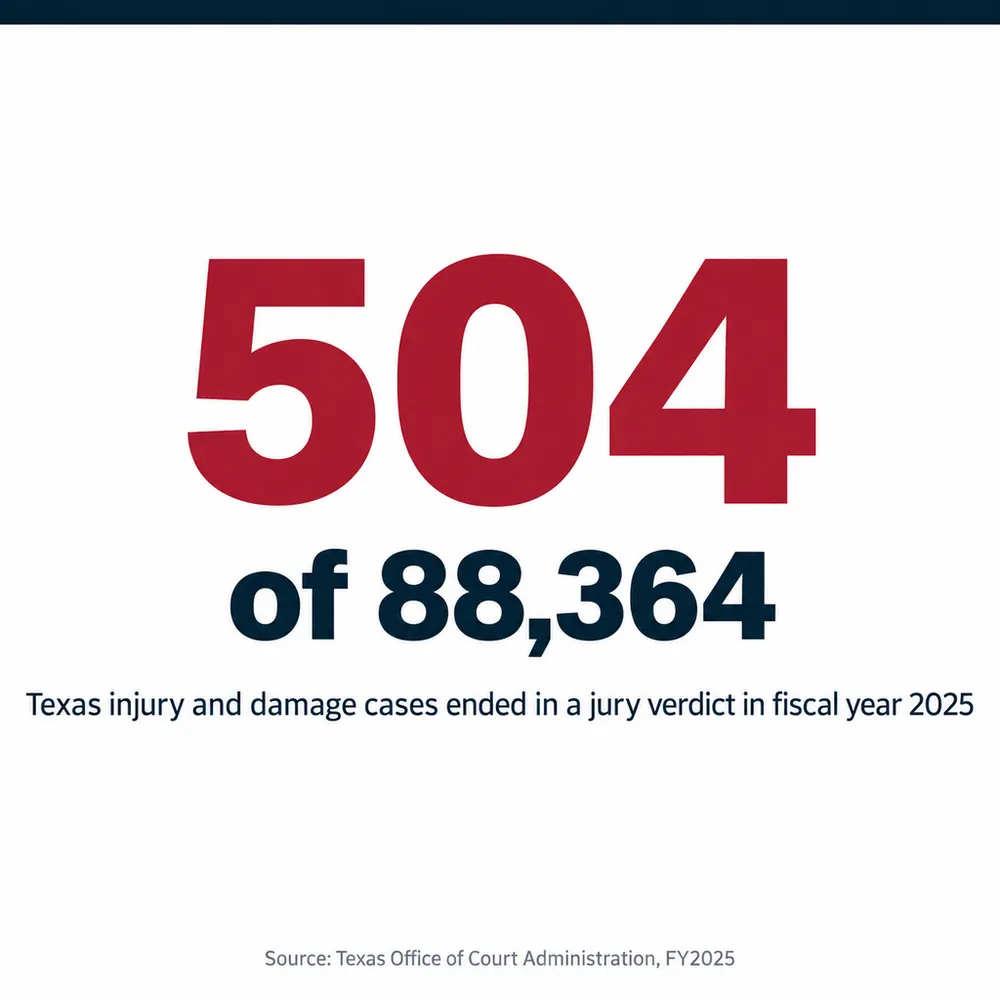
Most cases never see a jury. In fiscal year 2025, Texas district and statutory county courts disposed of 88,364 injury and damage cases, and 504 of them ended in a jury verdict, roughly half a percent, according to the Office of Court Administration’s statewide civil activity data. For motor vehicle cases specifically, it was 364 out of 69,343.
So why ask about trials at all? Because the possibility of one is what the other side is pricing. An adjuster evaluating your claim is making a judgment about what happens if this file doesn’t settle. A lawyer who has never taken a case to verdict and a lawyer who has are two different problems in that calculation.
I’ll be straight about the limits of that argument. The court data show that jury verdicts are rare. They do not show that insurers pay more when a lawyer has trial experience. Nobody has published a study measuring that. What I can tell you is that after years spent evaluating claims from the insurance side, I know how those files get scored, and who the plaintiff’s lawyer is factors in. Treat that as my read, not as a statistic.
So ask it this way. Have you personally tried a case like mine, and would you try this one if the offer isn’t fair? A trial count on its own tells you less than the answer to that. Listen for whether the answer is about the firm or about the person sitting across from you.
How to check a Texas lawyer’s license and record
This takes about five minutes and it’s free.
- Search the State Bar of Texas Find a Lawyer directory. Match the Bar Card number, not just the name, because similar names are common.
- Confirm the status line reads eligible to practice in Texas.
- Read the public disciplinary history. Public reprimands, suspensions, disbarments, and resignations in lieu of discipline appear there.
Know what the profile doesn’t show. Private reprimands, pending grievances, and dismissed grievances are confidential. Admissions in other states and in federal courts are self-reported and should be confirmed with that jurisdiction. And a clean record is the floor, not the ceiling. All it tells you is that nothing public has gone wrong.
How to read a personal injury lawyer’s reviews
Read reviews for patterns rather than star counts. The useful ones describe communication, expectation setting, and whether the person felt informed. A review saying a lawyer explained a decline honestly tells you more than a five-star review with no detail. Keep volume in perspective too. Injury clients often don’t want anyone knowing they hired a lawyer, so review counts in this field run lower than in most businesses and aren’t a good proxy for how busy or effective a firm is. Mine are here if you want to read them the same way.
What to check in the fee agreement before you sign
Personal injury work in Texas is done on contingency. You pay nothing up front, and the fee comes out of the recovery. TexasLawHelp, the free legal information site run by Texas Legal Services Center, describes 33.33 percent to 40 percent as the typical range, commonly a third before a lawsuit and 40 percent once litigation starts. Texas sets no cap and no standard rate, and percentages are negotiable. My own structure, and the full breakdown of what comes out of a settlement, is on my what a personal injury lawyer costs in Houston page.
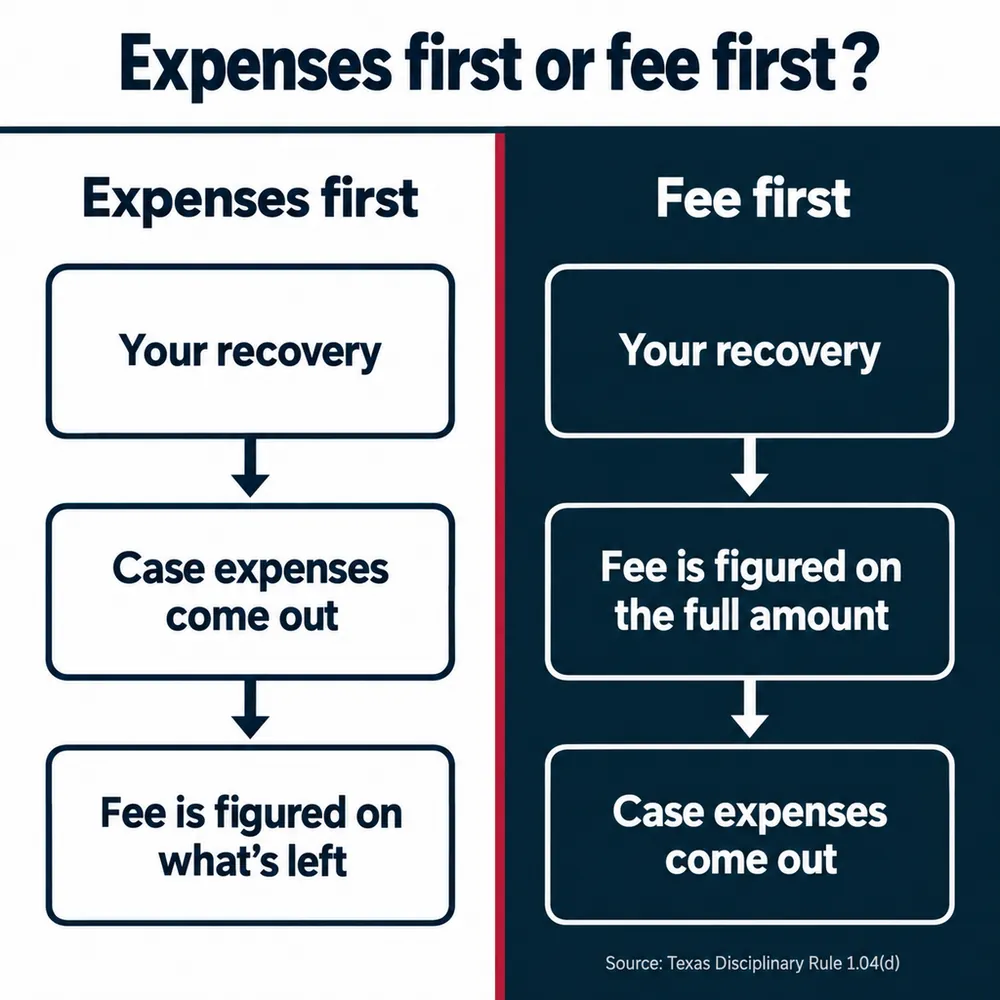
The percentage isn’t the part that trips people up. Texas Government Code Section 82.065 requires a contingent fee contract to be in writing and signed by both the attorney and the client. Disciplinary Rule 1.04(d) requires that agreement to state the method of computing the fee, including each percentage that applies at settlement, at trial, and on appeal if they differ, which expenses will be deducted from the recovery, and whether those expenses come out before or after the fee is calculated.
That last one is the question that changes your check the most, and it’s the one that gets skipped. Two lawyers can both quote you a third and hand you materially different checks, because case expenses can be deducted before the fee is figured or after it. Ask which order applies, and ask them to walk you through the arithmetic on a hypothetical number until you can follow it. A lawyer who can’t or won’t explain their own fee agreement in plain English is telling you something.
What to bring to a free consultation
Bring what you have. Don’t delay the call to assemble a perfect file, especially if a 90-day or six-month notice period could be running.
- The crash report, if one exists
- Photos and video from the scene, your injuries, and any vehicle damage
- Anything you’ve received from an insurance company, including letters, emails, and voicemails
- Medical records and bills you already have in hand
- Names and phone numbers of witnesses
- Documentation of missed work
- A dated timeline of what happened and every conversation you’ve had since
On the crash report specifically, Texas peace officers must file a report within 10 days when a crash involves injury, death, or apparent property damage of $1,000 or more to one person’s property. Reports cost $6 through TxDOT’s crash report system, or $8 certified, which you only need for court. Reports usually aren’t available right away, since the officer has up to 10 days to file. Or skip the state system and let me get it. I’ll request your Texas crash report for you at no charge.
Questions to ask a personal injury lawyer at the consultation
Who will handle my case day to day?
You want a name. If the answer is a department or a role, ask who the person is and how often you’ll speak with them.
Have you personally tried a case like mine to a jury?
Trials are rare, so the answer may be a small number. What you’re listening for is whether the lawyer has done it and whether they would do it in your case.
How do you expect fault to be divided, and what would you do about it?
Texas bars recovery entirely if you’re more than 50 percent responsible, so this question goes directly to whether you have a case and what it’s worth.
What is your fee, and when does it change?
Get the percentage at each stage: pre-suit, after suit is filed, and on appeal. It has to be in the written agreement anyway.
Are case expenses deducted before or after your fee is calculated?
This is the one that separates a real conversation from a sales pitch. Both orders are legal. You just need to know which one you’re agreeing to.
What’s my case worth?
Nobody can answer this honestly at a first meeting, and anyone who gives you a number should worry you. What a lawyer can do is explain what drives value: liability, the seriousness of the injuries, the available insurance, and how fault is likely to be allocated.
How long will this take?
Personal injury cases commonly run a year or more, and filing suit can add one to two years on top of that. Gathering complete medical records is usually the slowest part, and it’s the part you can’t skip, because insurers don’t pay for damages that aren’t documented.
Red flags when hiring an injury lawyer
A guarantee of any kind. Nobody can promise you an outcome or a dollar amount. The Texas advertising rules bar communications that create unjustified expectations about results, and a lawyer willing to break that rule to sign you is showing you how they operate.
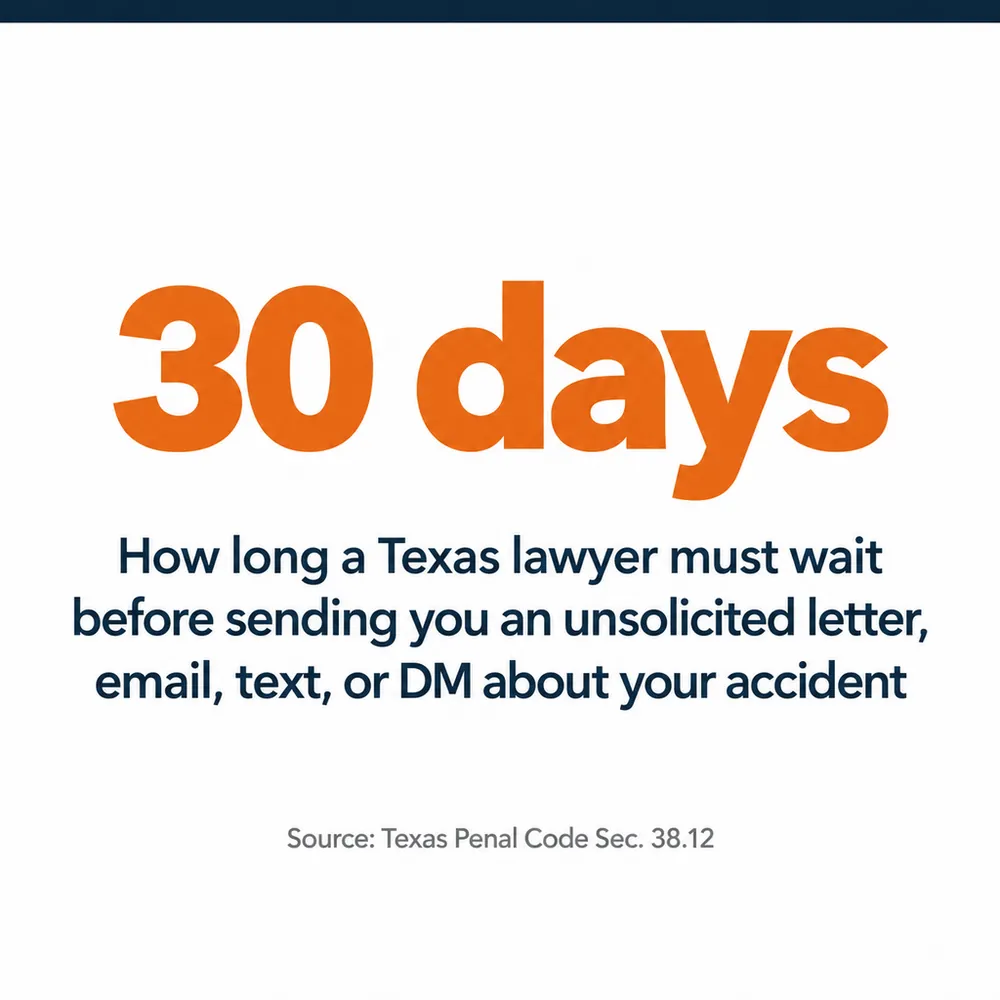
Contact you never asked for. This one has criminal law behind it. Under Texas Penal Code Section 38.12, it is an offense for an attorney to send an unsolicited written or electronic communication about a personal injury or wrongful death matter before the 31st day after the accident, and it’s a Class A misdemeanor. Soliciting in person or by phone, and paying anyone to bring in clients, is a third-degree felony. House Bill 2733, effective September 1, 2025, wrote social media direct messages and other electronic communications into that same solicitation provision, so a cold text or DM after a wreck is now spelled out in the statute. If someone found your name on a crash report and messaged you three days after your wreck, that is not attentiveness.
There are civil penalties too. Someone who was illegally solicited and never signed can recover a $50,000 penalty, a figure raised from $10,000 by House Bill 4325, effective September 1, 2025. A client who did sign a contract procured through barratry can void it and recover the fees and expenses paid plus a $10,000 penalty.
Pressure to sign today. A real deadline is worth explaining calmly. Urgency manufactured in the room is a sales tactic.
No written fee agreement, or one you’re asked to sign without reading. It has to be in writing and signed. Take it home if you want to.
What to do if another firm already turned you down
A decline is not a ruling. No court has looked at your case. One firm read the evidence, weighed it against its own caseload, economics, and case mix, and passed. Another lawyer can read the same facts differently, and often does.
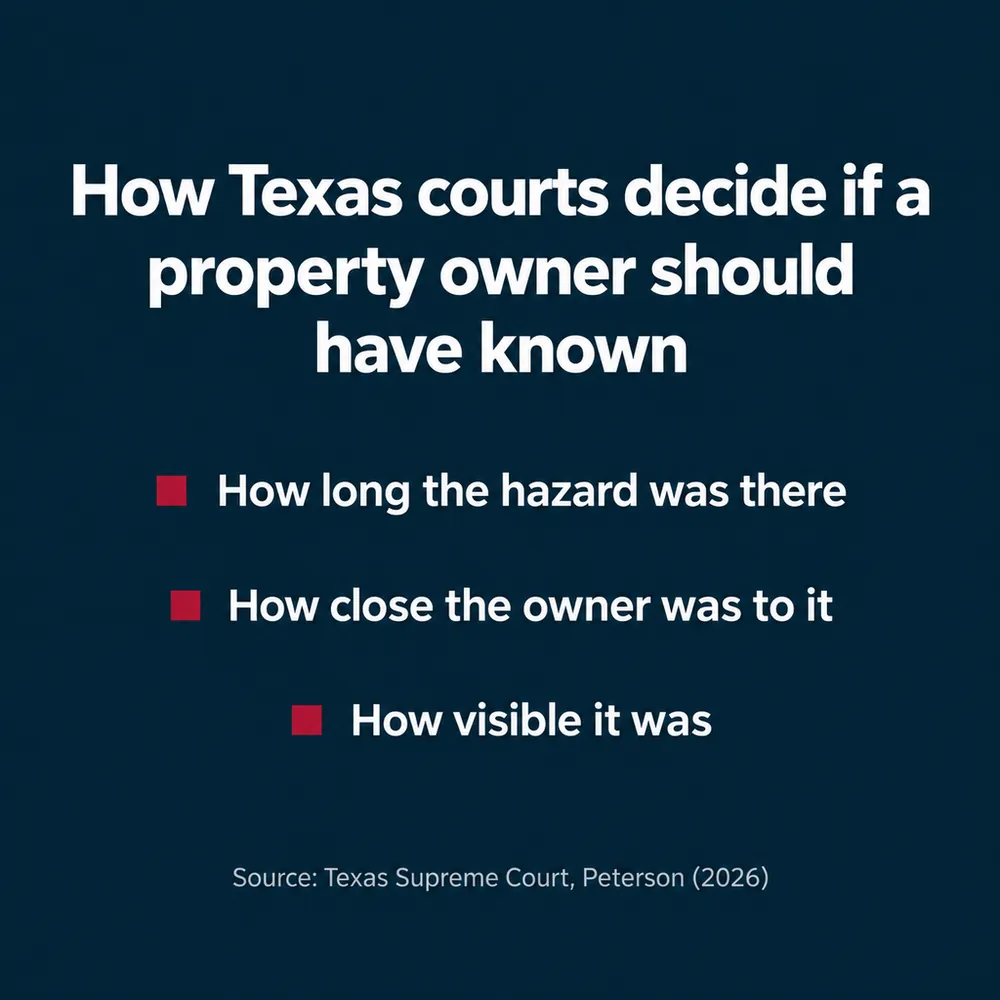
Slip, trip, and fall cases are the ones I see turned down most often, and the reason is what Texas law makes you prove. An injured visitor generally has to prove four things. The property owner knew or should have known about a dangerous condition (the law calls that actual or constructive knowledge). The condition posed an unreasonable risk. The owner failed to take reasonable care to fix it or warn about it. And the condition caused the injury. Constructive knowledge comes down to evidence about time. In Wal-Mart Stores v. Reece, the Texas Supreme Court held that proof the hazard existed long enough for the owner to have discovered it is required, and that an employee simply being nearby is not enough. The Court reinforced that in H-E-B v. Peterson, decided April 10, 2026. Evidence of earlier roof leaks elsewhere in the store wasn’t enough to show the store knew about the specific puddle. What matters is how long the condition existed, how close the owner was to it, and how visible it was.
There’s a second hurdle. Under Austin v. Kroger Texas, a property owner generally owes no duty to warn about or protect against a condition that was open and obvious or already known to the person who got hurt, with limited exceptions.
That’s a demanding standard. “I fell and there was water on the floor” does not by itself establish liability. These cases take real investigative work, and the evidence that decides them, store video most of all, gets overwritten fast. Some firms have simply decided the work isn’t worth it for them.
A large share of my practice is premises liability, including slip and fall cases other attorneys have already passed on. I’m not going to tell you every declined case is winnable, because that isn’t true. I’ll tell you it’s worth a second read, and that the second read should happen soon, while the video still exists.
What to expect on communication once you hire someone
Set this expectation before you sign, not after.
Ask three things. How quickly do you return calls, who calls me with updates, and what does a normal month look like on a case like mine. Then hold the answer against reality.
There will be long, quiet stretches, particularly while medical records are being collected. That phase is slow, it’s largely out of your lawyer’s hands, and it’s also the phase that determines what your damages look like on paper. Quiet doesn’t mean nothing is happening, but you should know it’s coming so the silence doesn’t feel like neglect.
The one thing you shouldn’t accept is not knowing who to call. That’s why I hand clients my cell number instead of routing them through anyone.
Talk to me before the clock starts working against you
If you were hurt in the Houston area and you’re trying to figure out what to do next, call me. The consultation is free, my phones are answered around the clock by an actual person, and I’ll give you a straight read on whether you need an attorney at all. If you do, there’s no fee unless I win.
I practice from one office in Houston, I take cases across the greater Houston area, and I handle consultations in English and Spanish. If a government entity might be involved in what happened to you, don’t wait on this. Get in touch and let’s talk about your case.
Jeff Todd, Personal Injury Attorney · 12929 Gulf Freeway, Suite 301, Houston, TX 77034 · (832) 243-4953
This article is general information about choosing a personal injury lawyer in Texas, not legal advice about your situation, and reading it does not create an attorney-client relationship. Every case is different. See the full disclaimer.