

If you were hurt in a Texas car accident and needed medical treatment, talk to a lawyer before you give the other driver’s insurance company a recorded statement or accept a settlement offer. If nobody was hurt, the other driver’s insurer accepts fault, and it’s paying a fair amount to fix or replace your car, you probably don’t need a lawyer.
I’m Jeff Todd, a Houston personal injury attorney with about 25 years of legal experience. “Do I even need an attorney for this?” is one of the most common questions I get on the phone. I answer it honestly, even when the honest answer means I don’t get the case. I also spent the early part of my career representing insurance companies, so I know how the other side sizes up a car wreck claim. Here’s how to tell which side of the line your crash falls on, and what to do next either way.
Key Takeaways
- If you were hurt and needed treatment, get legal advice before you give the other driver’s insurer a recorded statement or sign a release.
- If nobody was hurt and the insurer accepts fault, you can usually handle the claim yourself and keep the whole check.
- Texas bars you from recovering anything if you’re found more than 50% at fault, so a fight over fault is worth taking seriously.
- You generally have two years to file a lawsuit, but a crash with a City of Houston vehicle requires written notice within 90 days.
- My fee is 33% before a lawsuit, 40% after one is filed, and 45% on appeal. There’s no fee unless I win.
Do I Need a Lawyer for a Car Accident in Texas? Quick Answer by Situation
| Your situation | Do you need a lawyer? | Why |
|---|---|---|
| Nobody hurt, fault accepted, fair repair or total-loss offer | Probably not | A car-only claim is usually simple to document and settle yourself. |
| Dented car and a sore neck you haven’t had checked | See a doctor first, then decide | Some injuries take hours or days to show up. |
| Minor injury, clear fault, simple insurance picture | Maybe. A free consultation will tell you. | The fee has to be worth what a lawyer adds. |
| Ongoing treatment, lasting pain, or missed work | Yes, before you settle | A signed release can end your injury claim for good. |
| The insurer says you’re partly or mostly at fault | Yes | More than 50% at fault means no recovery in Texas. |
| Uninsured or underinsured driver, and you were hurt | Yes | Your own coverage has its own rules and proof requirements. |
| 18-wheeler, delivery truck, company vehicle, or rideshare | Yes, early | More parties, more insurance, and some records only have to be kept six months. |
| City, county, or METRO vehicle | Yes, right away | Notice deadlines can be as short as 90 days. |
| You were hurt while working | Yes | You may have a workers’ comp claim and a claim against the other driver. |
| Serious injury or a death | Yes | Future care, lost earnings, and family claims are hard to value on your own. |
| The insurer is stalling, denying, or rushing you | Yes, if a written request doesn’t fix it | Something is holding up the claim, and you need to know what. |
Do You Need a Lawyer If the Car Accident Wasn’t Your Fault?
Not automatically. Texas is an at-fault state, so the driver who caused the crash is responsible for your damages, along with that driver’s insurance company. Fault tells you who pays. Whether you need a lawyer comes down to three other questions:
- Were you hurt?
- Is the other driver’s insurer accepting responsibility?
- Is there enough insurance to cover what you lost?
Plenty of not-my-fault wrecks end with a claim number, a repair estimate, and a few phone calls. Others turn into a fight once the adjuster blames you, or your bills outgrow the other driver’s policy.
When You Probably Don’t Need a Lawyer After a Car Accident
You probably don’t need a lawyer when all three of these are true:
- Nobody was hurt.
- The other driver’s insurance company accepts fault.
- The offer reasonably covers your repairs or the value of your car.
A big repair bill doesn’t change that on its own. A $9,000 repair on a crumpled fender and door is still just a car claim. If the insurer is being reasonable, handle it yourself and keep the whole check. The Texas Department of Insurance explains how to file directly with the other driver’s insurer.
If the other driver’s insurer hasn’t accepted fault yet, you can go through your own collision coverage instead. You’ll pay your deductible, and your insurer can go after the other driver’s company for reimbursement. The catch is that liability-only coverage won’t pay to fix your own car.
How to Handle a Property-Damage-Only Claim Yourself
- Document everything. Photograph the scene and both cars, and get names and phone numbers from any witnesses. Keep every estimate and receipt.
- Tell your own insurer. Report the crash to your own company even if you plan to claim against the other driver. Your policy requires prompt notice.
- Open a claim with the other driver’s insurer. Write down the claim number and the adjuster’s name, direct phone number, and email.
- Get the crash report. The official Texas Peace Officer’s Crash Report (form CR-3) is available through TxDOT for $6, or $8 for a certified copy. You can also request your Texas crash report through my site at no cost. Officers have 10 days to file their reports, so yours may not be ready right away. The report is evidence, not the last word on fault.
- Pick your own repair shop. The insurer can suggest a shop, but it can’t make you use one. Ask your shop to document any extra damage it finds once the car is taken apart, and send that to the adjuster.
- Back up a total-loss valuation with comparables. If your car is totaled, find listings for similar vehicles for sale near you. Actual cash value means what your specific car was worth right before the crash. It doesn’t mean what you still owe on the loan or what a new one costs.
- Read any release before you sign it. Make sure a property damage release covers only your car. If there’s any chance you were hurt, don’t sign anything that also releases your injury claim.
Can You Get Diminished Value After a Car Accident in Texas?
Possibly, if the other driver’s insurer is paying your claim. Generally not, if your own collision coverage is paying and the car was fully repaired. Diminished value is the drop in what your car is worth because it now has a wreck in its history, even after a perfect repair.
| Whose insurance is paying | Is diminished value owed? |
|---|---|
| The other driver’s insurer (a third-party claim) | It may be, even if the repair is complete |
| Your own collision coverage (a first-party claim) | Generally no, if the car is fully repaired |
The Texas Department of Insurance laid out both rules in Commissioner’s Bulletin B-0027-00. The Texas Supreme Court reached the same conclusion on first-party claims in a 2003 case, American Manufacturers Mutual Insurance Co. v. Schaefer. If the at-fault driver’s insurer is paying, bring up diminished value yourself.
What If the Insurance Company Won’t Pay Fairly for Your Car?
Push back in writing, with evidence, before you think about hiring anyone. On a property claim, you have several options:
- Ask the adjuster, in writing, what the estimate left out.
- Send your shop’s estimate, photos of the added damage, or comparable vehicle listings.
- If the dispute is with your own insurer and it’s about the amount rather than whether you’re covered, check your policy for an appraisal process. Appraisal has its own costs, and it only settles the dollar amount.
- Call the Texas Department of Insurance’s consumer help line at 800-252-3439, weekdays from 8 a.m. to 5 p.m. Central. TDI can’t decide who caused a crash, and it has limited power when another driver’s insurer is disputing liability.
If there’s still a big gap after all that, a short call with a lawyer can tell you whether a lawsuit makes financial sense. When the difference is a few hundred dollars, it usually won’t.
When Is It Worth Getting a Lawyer for a Car Accident?
A lawyer is worth talking to once there’s an injury, a fight over fault, or a complicated insurance picture. Crash injuries are common in Texas. TxDOT counted 244,534 people injured in 2025 alone. If your crash fits any of the situations below, talk to a lawyer before you settle. These are the claims I take on as a Houston car accident attorney.
You Were Hurt, Even If the Pain Showed Up Days Later
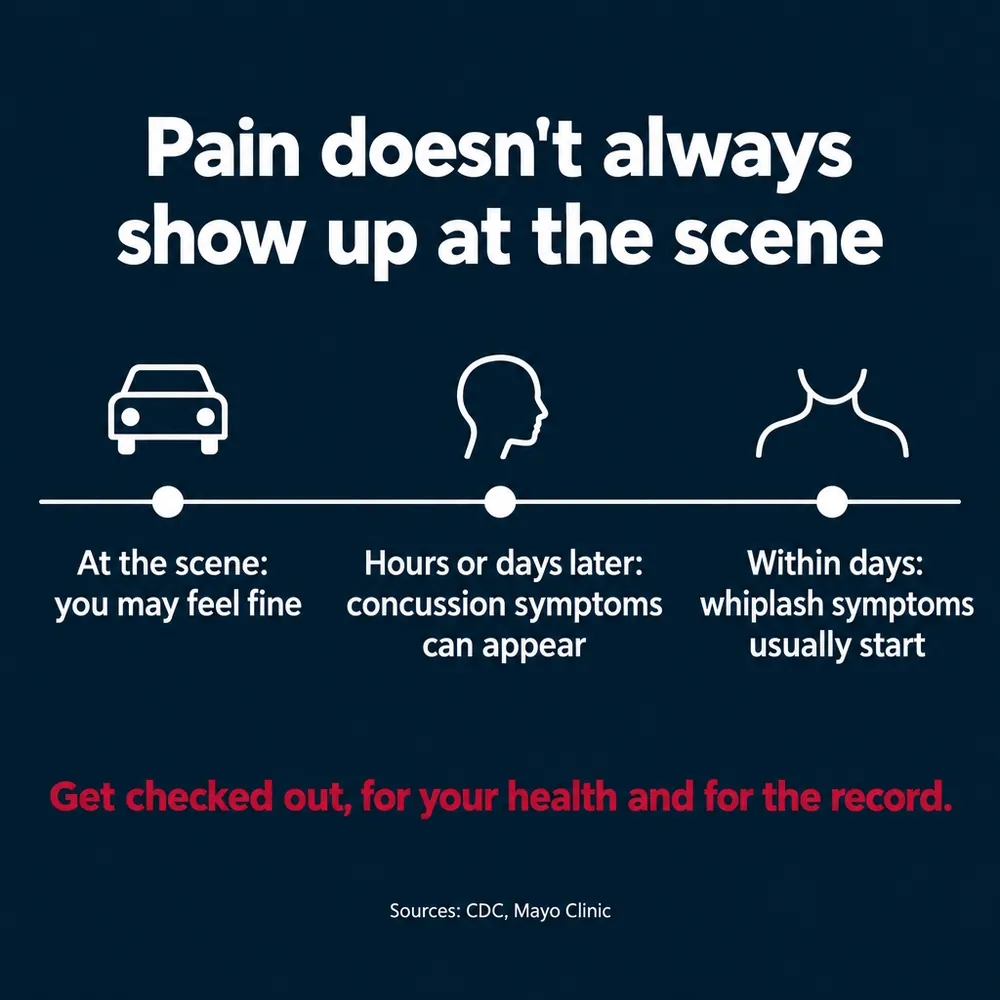
If you needed medical treatment, talk to a lawyer before you settle. That includes pain that didn’t show up at the scene. The CDC notes that concussion symptoms can appear hours or days after the injury, and Mayo Clinic says whiplash symptoms usually start within days. You can walk away from a wreck feeling fine and wake up two days later unable to turn your head.
Get checked out, for your health and for the record. No Texas rule says you lose your claim if you wait a few days to see a doctor. Insurers know the gap argument well, though. If you were really hurt, why didn’t you go sooner?
Before you settle an injury claim, you should know:
- Whether your treatment is finished
- How much work you’ve missed
- Whether you’ll need care down the road
- Whether the paperwork closes out all of your injury claims
The Texas Office of Public Insurance Counsel warns that signing a release can keep you from getting any more money for the injury, even if it turns out to be worse than you thought. Once you sign, there’s no going back for more.
The Insurance Company Is Blaming You for the Crash
Texas uses a system called proportionate responsibility. Under Chapter 33 of the Civil Practice and Remedies Code, you can’t recover anything if your share of the blame is more than 50%. At 50% or less, your damages get cut by your percentage.
| Your share of fault | What happens to your recovery |
|---|---|
| 0% | Not reduced |
| 20% | Reduced by 20% |
| 50% | Reduced by half |
| 51% or more | Nothing |
Source: Texas Civil Practice and Remedies Code Sections 33.001 and 33.012.
That’s why a fault dispute matters even when you’re sure you did nothing wrong. Say an adjuster claims you were speeding and pins 30% of the crash on you. That 30% comes off the top of everything you’re owed. The other side can also point at someone who isn’t in the case, like a third driver, to spread the blame around.
The percentage an adjuster throws out is a negotiating position. Only a judge or jury decides fault in a lawsuit. A big part of my job is gathering the evidence that answers the insurer’s version of events.
The Other Driver Is Uninsured or Underinsured
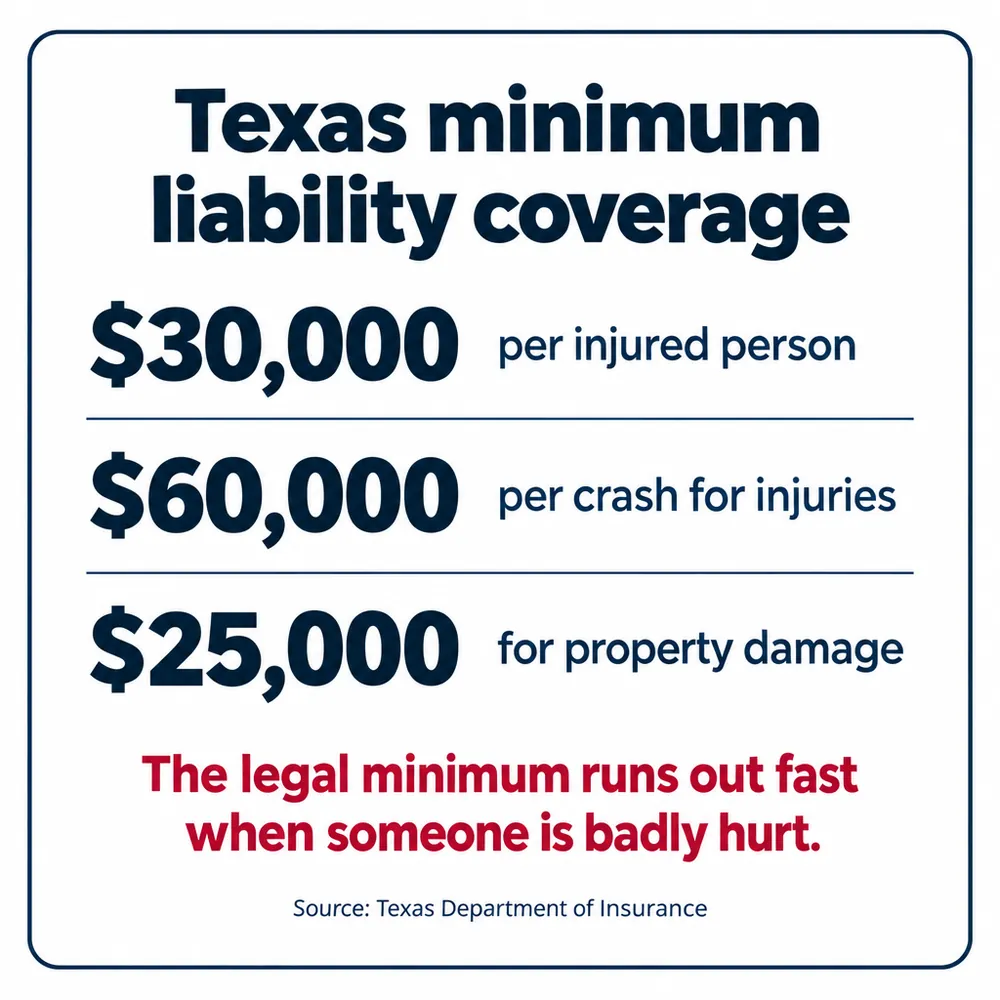
Texas only requires drivers to carry 30/60/25 liability coverage. That means $30,000 per injured person, $60,000 per crash for injuries, and $25,000 for property damage. It’s the legal minimum, and it runs out fast when someone is badly hurt. Some drivers don’t carry any insurance at all.
Your own policy may fill the gap:
- Uninsured/underinsured motorist coverage (UM/UIM) pays when the at-fault driver has no insurance or not enough.
- Personal injury protection (PIP) pays medical bills, part of your lost wages, and some household help, no matter who caused the crash.
- Medical payments coverage (MedPay) pays medical and funeral costs, also regardless of fault.
Texas insurers have to offer UM/UIM and PIP, and you can only turn them down in writing. Pull out your policy before you assume you’re out of luck.
Even though UIM is your own coverage, Texas courts have held that your insurer generally doesn’t have to pay UIM benefits until the other driver’s fault and underinsured status are established, often through a court judgment. Your own insurance company can end up being the one you’re negotiating against. And for a hit-and-run, Texas law requires physical contact with the other vehicle before uninsured motorist coverage applies.
An 18-Wheeler, Delivery Truck, Company Vehicle, or Rideshare Was Involved
18-wheeler and commercial truck crashes work differently from a wreck between two neighbors, whether it’s a tractor-trailer on I-10 or a delivery van on a residential street. There are usually more parties involved, like the driver, the employer, and sometimes a separate owner or trucking company. There’s usually more insurance, too. Federal rules require interstate freight carriers to carry at least $750,000 in liability coverage under 49 CFR 387.9. That’s far more than a personal auto policy, and many carriers hold well above the minimum.
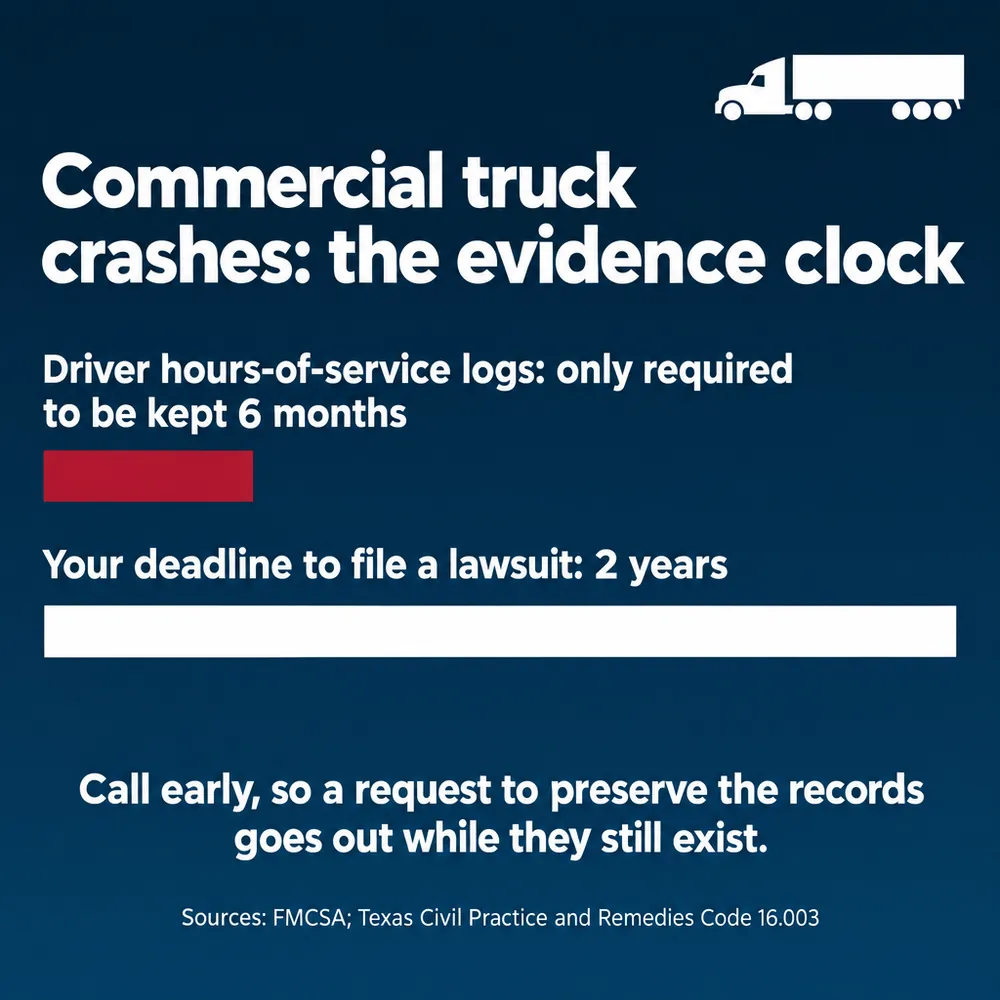
The bigger issue is evidence. FMCSA only requires motor carriers to keep drivers’ hours-of-service records and supporting documents for six months. You have two years to file a lawsuit, but those logs can be legally thrown out after six months. That’s a strong reason to call a lawyer early, so a request to preserve the records goes out while they still exist.
A company logo on the door doesn’t automatically make the company responsible. That depends on whether the driver was on the clock, who owns the vehicle, and how the businesses are connected.
Rideshare crashes turn on a different question. What was the driver’s app doing at the moment of impact? Texas law treats a driver who’s logged in and waiting for a request differently from one who has accepted a ride, and TDLR warns that a personal auto policy may not cover rideshare driving. The trip data that answers the question sits with the rideshare company.
A City, County, or METRO Vehicle Hit You
If a city truck, county vehicle, police car, or METRO bus was involved, the clock can be much shorter than two years. The Texas Tort Claims Act only allows certain claims against government entities, caps how much you can recover, and generally requires written notice within six months. Some entities set their own deadlines:
- The City of Houston requires written, verified notice within 90 days.
- METRO’s notice of claim form says to submit it within 180 days of the incident.
The first job is figuring out exactly who owned the vehicle. If a government vehicle was involved, call a lawyer right away. Don’t count down to the last day.
You Were on the Job When the Crash Happened
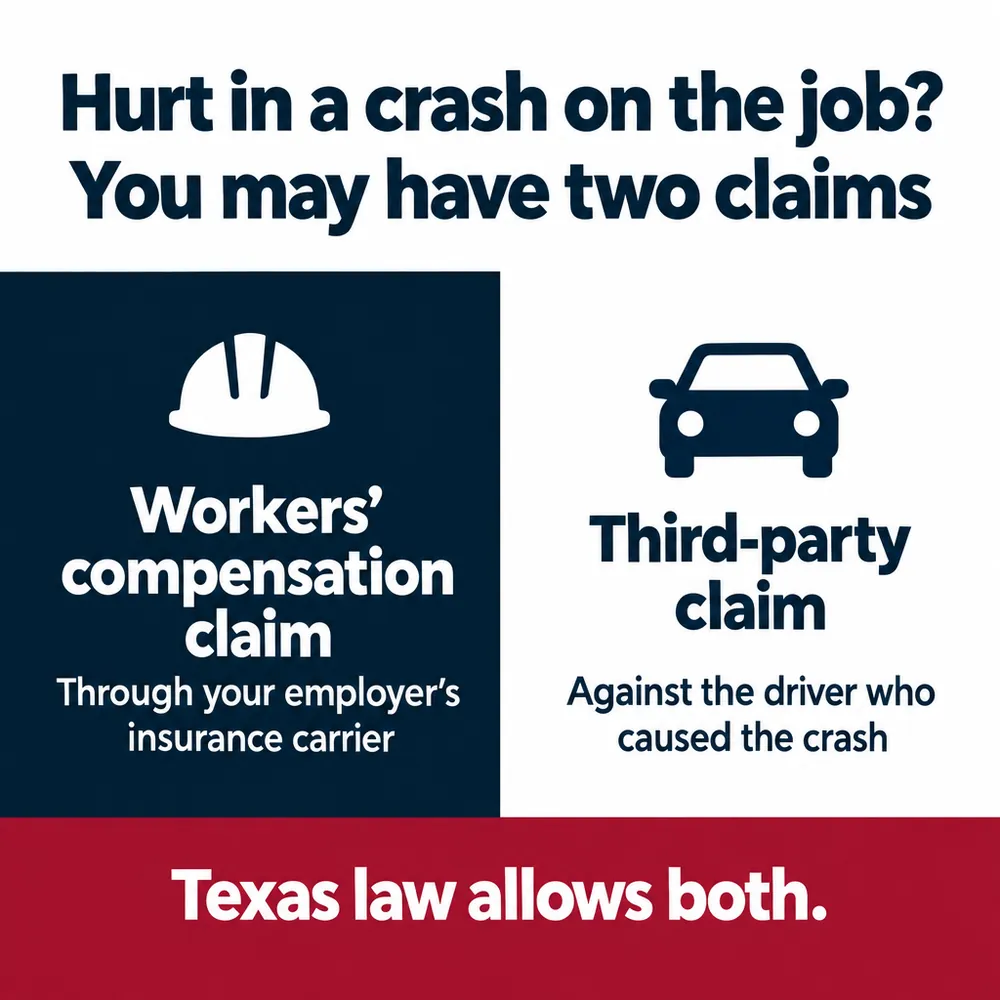
If you were driving for work, or another driver hit you while you were working, you may have two claims at once:
- A workers’ compensation claim through your employer’s insurance carrier
- A third-party claim against the driver who caused the crash
Texas law allows both. It isn’t double-dipping, because the workers’ comp carrier gets paid back out of the third-party recovery for what it already covered. If your employer carries workers’ comp, those benefits are generally your only remedy against the employer. That makes the claim against the other driver even more important. Texas is also the only state that lets private employers opt out of workers’ comp entirely. Those employers are called nonsubscribers, and an injured employee can sue them directly for negligence.
I don’t handle standalone workers’ comp claims. I do handle the third-party claim against the at-fault driver when someone is hurt in a crash on the job. Watch a separate deadline, too. The Texas Division of Workers’ Compensation says to report a work injury to your employer within 30 days to protect your benefits. That clock has nothing to do with the two-year lawsuit deadline.
Someone Was Seriously Injured or Killed
A catastrophic injury, like a brain or spinal cord injury or one that keeps you from working, has to account for medical care and lost earnings years into the future. A quick settlement based on the bills you have today won’t capture that.
When someone dies in a crash, Texas law gives a wrongful death claim to the surviving spouse, children, and parents. A separate survival claim covers what the person who died could have claimed themselves. They’re different claims with different owners. The two-year deadline for a wrongful death lawsuit runs from the date of death, which isn’t always the date of the crash.
If you lost someone in a wreck, I’m sorry. When you’re ready to look at the legal side, you can read more about how wrongful death claims work in Houston.
The Insurer Is Stalling, Denying, or Rushing You to Settle
Not every delay is bad faith. Adjusters wait on medical records, police reports, and approvals. If the insurer denies your claim, stops returning calls, or pushes you to settle before you know how badly you’re hurt, get a second opinion.
You’ll see claims online that the other driver’s insurer has to pay within 15 days. Texas’s prompt-payment deadlines apply to claims under your own policy, and the Texas Department of Insurance says those deadlines don’t apply when another driver’s insurer is paying.
For a slow claim with the other driver’s insurer:
- Ask in writing what information is missing.
- Ask in writing why it’s taking so long.
- Keep copies of everything.
If the claim still doesn’t move, that’s a good time to call a lawyer.
Why Does the Other Driver’s Insurance Company Want a Recorded Statement?
The adjuster wants your version of the crash and your injuries on the record early, before you know the full extent of either. I know how these calls work because I spent the early part of my career on the other side of them, representing insurance companies.
The adjuster works for the company paying the claim. Their job is to estimate what the claim is worth to that company. Most adjusters are doing exactly what they’re paid to do. Just remember who’s paying them.
A recorded statement is a question-and-answer session the adjuster records, and what you say can come back later as evidence. The usual trouble spots:
- Saying “I’m fine” before a doctor has looked at you
- Guessing at speeds, distances, or how long the light was yellow
- Saying “I’m sorry,” which can get framed as admitting fault
- Talking about old injuries or aches you had before the crash
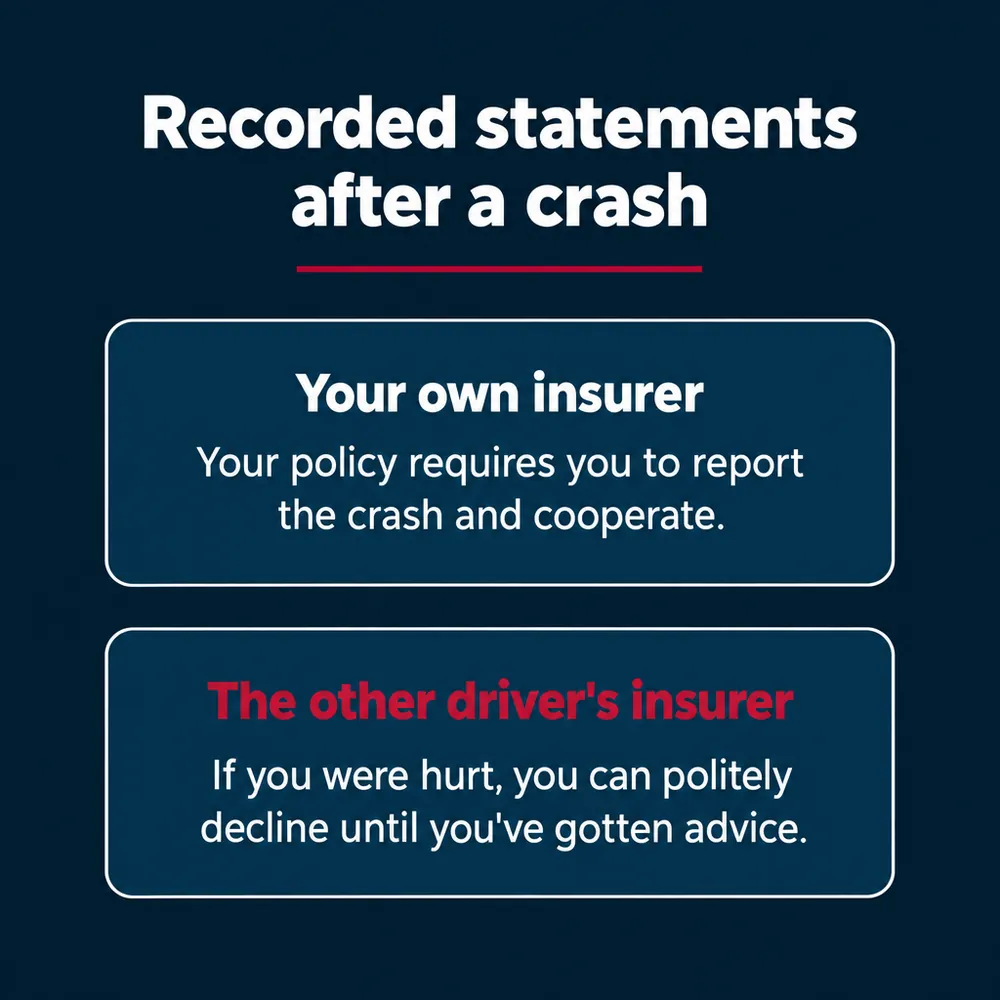
Your own insurer is a different story. Your policy requires you to report the crash and cooperate with your own company. The other driver’s insurer doesn’t have that hold on you. If you were hurt, it’s reasonable to politely decline a recorded statement to the other driver’s insurer until you’ve gotten advice.
Quick settlement offers deserve the same caution. The check comes with a release, and signing it ends the injury claim for good.
Once you hire a lawyer, the adjuster deals with the lawyer instead of you. The claim gets valued on your complete medical records rather than a phone call from the day after the wreck. And the insurer has to factor in that the case can end up in front of a jury.
Do I Need a Lawyer for a Minor Car Accident?
If nobody got hurt, probably not. If you did get hurt, even a little, it depends on the offer. “Minor” should describe your injuries and losses, not how the bumper looks. A low-speed rear-end crash in Gulf Freeway traffic can still cause an injury that needs treatment.
The real gray zone is a minor injury with clear fault. You got checked out, had a handful of appointments, you’re feeling better, and the other driver’s insurer admits its driver caused the crash. Honestly, it can go either way. Sometimes the insurer makes a fair offer, and a lawyer’s fee would eat most of what a lawyer could add. Sometimes the adjuster is ignoring part of your bills or lowballing your missed work, and that’s where a lawyer earns the fee.
If you’d rather handle a small injury claim yourself:
- Wait until your treatment is finished, so you know the full bill.
- Gather your medical records, bills, and proof of any missed work.
- Put your demand in writing, with the numbers attached.
- Read the release before you sign, because it ends the claim for good.
A consultation with me is free, and I’ll tell you which situation you’re in. If it’s the first one, I’ll say so.
Who Pays Your Medical Bills While the Claim Is Pending?
Not the other driver’s insurer, at least not yet. It generally pays once, at the end, in a single settlement. In the meantime, a few things can cover treatment:
- Your own PIP or MedPay, which pay regardless of who caused the crash.
- Your health insurance, which can pay now and get reimbursed out of your settlement later.
- A letter of protection, where a provider agrees to treat you now and be paid out of the settlement.
Under Section 55.002 of the Property Code, a hospital can put a lien on your claim if you’re admitted within 72 hours of the crash. That’s a rule about hospital liens, not a deadline to see a doctor.
How Much Does a Car Accident Lawyer Cost in Texas?
Most Texas car accident lawyers work on contingency. That means the lawyer takes a percentage of the recovery and gets nothing if there’s no recovery. Here’s what I charge as a Houston personal injury attorney:
| When the case resolves | My fee |
|---|---|
| Before a lawsuit is filed | 33% |
| After a lawsuit is filed | 40% |
| On appeal | 45% |
The consultation is free, you pay nothing up front, and there’s no attorney’s fee unless I win. The fee comes out of the recovery when the case resolves. It steps up because filing suit and handling an appeal take a lot more time and resources. I break down how much a personal injury lawyer costs in Houston in more detail in a separate article.
Before you sign with any lawyer, ask about two more things:
- Case expenses. Costs like filing fees and medical records are separate from the attorney’s fee. Ask how they’re handled and who pays them if there’s no recovery. Texas law requires a contingency fee agreement to be in writing and signed, and the Texas Disciplinary Rules require it to spell out how expenses are deducted.
- Medical bills and liens. The hospital, health insurer, and workers’ comp claims above get paid out of the recovery, and negotiating them down is part of the job. What’s left after the fee, expenses, and those bills is what you actually take home.
When the Fee Can Outweigh What a Lawyer Adds
On a small claim, the math doesn’t always work. Say the insurer offers $6,000 for a minor injury, and a lawyer gets it up to $8,000 without filing suit. A 33% fee on $8,000 is $2,640, which leaves you $5,360 before any case expenses. You’d have been better off taking the first offer on your own.
An insurance-industry study points the same direction. In July 2026, the Insurance Research Council released an analysis of more than 7.4 million auto injury claims closed between mid-2017 and mid-2022. Claimants with lawyers waited a median of nearly 440 days for their claims to close, more than twice as long as people without lawyers. After medical costs and legal fees, they netted $1.40 per dollar of medical bills, compared with $1.80 for people without lawyers.
Take that with two grains of salt. The IRC is supported by insurance companies. It also isn’t an apples-to-apples comparison, since people tend to hire lawyers for the harder, more serious, and more disputed claims. What the study does back up is something I already tell callers. A lawyer isn’t worth it on every claim, and on a straightforward one, the fee and the extra time can outweigh what the lawyer adds.
When Should You Get a Lawyer After a Car Accident?
If you were hurt, talk to one before you give the other driver’s insurer a recorded statement or sign anything. After that, deadlines drive the timing.
| Deadline | Time limit | Applies to |
|---|---|---|
| Lawsuit for injury or property damage | 2 years from the crash | Most car accident claims |
| Wrongful death lawsuit | 2 years from the date of death | Fatal crashes |
| Notice to the City of Houston | 90 days | City-owned vehicles |
| Notice to METRO | 180 days | METRO buses and vehicles |
| Notice under the Texas Tort Claims Act | Generally 6 months | Other government vehicles, unless a shorter rule applies |
| Report the injury to your employer | 30 days | Crashes that happen on the job |
| Trucking company driver logs | Only required to be kept 6 months | Commercial truck crashes |
Sources: Texas Civil Practice and Remedies Code Sections 16.003 and 101.101; City of Houston; METRO; the Texas Division of Workers’ Compensation; FMCSA.
The two-year limit in Section 16.003 of the Civil Practice and Remedies Code is a deadline to file a lawsuit. Opening a claim, negotiating with an adjuster, or calling a lawyer doesn’t stop the clock. Negotiations alone can take months, so waiting until month 20 leaves very little room. Some exceptions exist, including for injured children, but don’t plan around one.
What Happens After You Hire a Car Accident Lawyer?
Here’s how it works when you hire me, Jeff Todd:
- Free consultation. I give you a candid read on whether you need a lawyer and what your options are.
- Sign up. If you decide to move forward, the electronic agreement takes a couple of minutes to sign.
- Building the case. My office gathers your medical records and bills, coordinates treatment where needed, and documents your injuries and losses.
- Settlement demand. Once the evidence is in, I send the insurance company a written demand.
- Lawsuit, if needed. If the insurer won’t pay fairly, I file suit. Most cases settle, partly because defendants know I have a history of taking cases to a jury when a fair offer isn’t on the table.
- Resolution. When the case resolves, I pay the outstanding medical bills and liens out of the recovery, and you get your share.
A property damage claim can wrap up in a few weeks. An injury claim usually can’t settle until your treatment is finished, so it often takes a year or more, and longer when a lawsuit is filed. Every case is different, and no lawyer can honestly promise you a specific result. Through all of it, you work directly with me. I handle the strategy and the negotiation personally, and I give clients my cell phone number. When you hire me, you get me.
Get a Straight Answer From a Houston Car Accident Lawyer
If you’ve been in a wreck and you’re still not sure whether you need a lawyer, call me at (832) 243-4953 or send me a message. A live person answers the phone 24/7, and I personally follow up, usually within minutes, with an honest read on your situation. The consultation is free. If you don’t need me, I’ll tell you that, along with what your options are.
My office is on the Gulf Freeway in southeast Houston, and I handle car accident cases across the greater Houston area. I speak English and Spanish.
This article is general information about Texas car accident claims, not legal advice about your situation, and reading it does not create an attorney-client relationship. Every case is different. See the full disclaimer.