

The Jones Act is a federal law, 46 U.S.C. § 30104, that lets a seaman who gets hurt on the job sue their employer for negligence. You may count as a seaman if you work on a drillship, a jack-up rig, a liftboat, a supply boat or another vessel in the Gulf, and you spend a large part of your working time aboard it. A Jones Act claim can pay you for pain and suffering and for the money you’ll lose in the future.
If you aren’t a seaman, a workers’ comp program usually covers you instead. Offshore and dock workers who aren’t crew members are usually covered by the Longshore and Harbor Workers’ Compensation Act, usually called the Longshore Act or LHWCA. It is a federal workers’ comp program for maritime workers. Workers with land-based jobs in Texas are usually covered by Texas workers’ comp. Both programs pay your medical bills and part of your lost wages, and neither one pays for pain and suffering. Both also have much shorter deadlines than the Jones Act, so you should find out early which law applies to you.
I’m Jeff Todd, and I’ve practiced law for about 25 years from my office in Houston. Jones Act and maritime injury claims are part of my practice, along with oilfield injury cases and boating and vessel accidents. I represent injured workers in Houston, the Galveston area and along the Gulf Coast. I spent the early part of my career defending insurance companies, so I know how the company’s insurer will look at your claim.
Who qualifies as a Jones Act seaman?
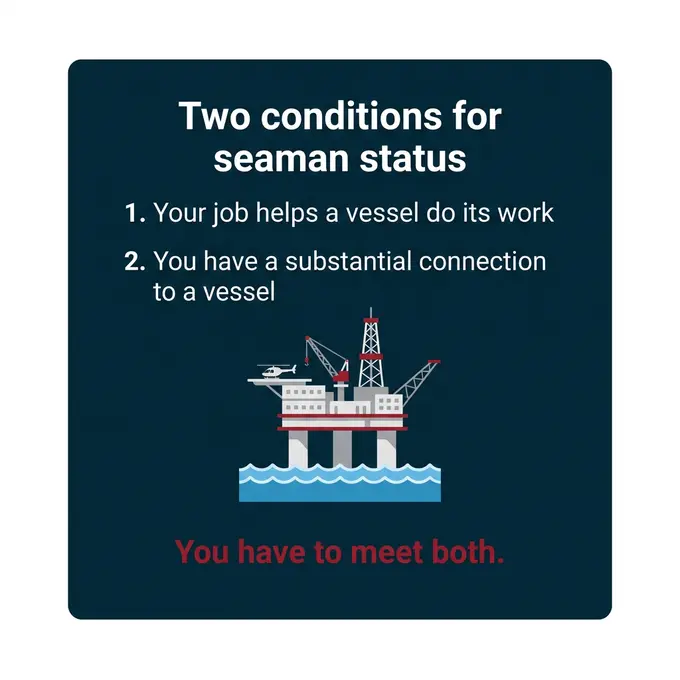
You qualify as a Jones Act seaman if you meet two conditions. Your job has to help a vessel do its work. You also have to have a substantial connection to a vessel. Courts judge that connection two ways: by how much of your working time you spend aboard, and by the kind of work you do there. Courts decide both by looking at your work for that employer as a whole, rather than at one hitch or the day you got hurt.
For example, picture a hand who is assigned to a jack-up rig, works all of his hitches aboard it and stays with the rig when it moves to a new location. His job helps the rig drill, nearly all of his working time is spent aboard a vessel, and he goes where the rig goes. That hand would likely meet both conditions.
Your job helps a vessel do its work
Your duties have to help the vessel run or help it do the job it’s out there to do. On a drillship, for example, that job is drilling. Work that supports the drilling counts, and so does work that keeps the ship running.
You have a substantial connection to a vessel
The vessel has to be a vessel in navigation, which means it is in service and able to travel on the water. It does not have to be moving at the moment you get hurt. A structure that is permanently moored, or a craft that has been taken out of the water for a long time, may not count.
Boat crews who move between vessels can count their time on all of them together, as long as the vessels belong to one group, such as one company’s fleet.
How much of your time has to be aboard a vessel?
As a general guideline, you usually won’t qualify as a seaman if less than about 30 percent of your working time with that employer is spent working aboard a vessel. Time you spend working on shore or on a fixed platform doesn’t count toward that figure, because neither one is a vessel. The 30 percent figure is a rough guideline, and a court can still decide that a worker below it is a seaman if the other facts about the job support it. Don’t assume you aren’t covered just because someone at the company told you that you don’t spend enough time on the vessel. Whether you meet this condition is usually a question for a jury, because the answer depends on the details of your job.
What kind of work counts?
Federal courts in Texas and Louisiana, which follow the Fifth Circuit, decide this by asking three questions:
- Do you belong to the vessel? The court asks whether the vessel is your workplace, or whether your real workplace is a shop, yard or office on shore.
- Is your work sea-based? The court asks whether your work is done out on the water, rather than at a dock or on land.
- Were you sent out for one job? The court asks whether you were sent to the vessel to do one specific job and then leave. A worker who stays aboard and moves with the vessel from one location to the next, including a rig that gets towed to a new site, is more likely to count as a seaman.
A worker employed by a shoreside shop and sent out to a rig to make one repair will usually fail these questions, even if the repair keeps him aboard for days.
Does the Jones Act apply to offshore oil workers?
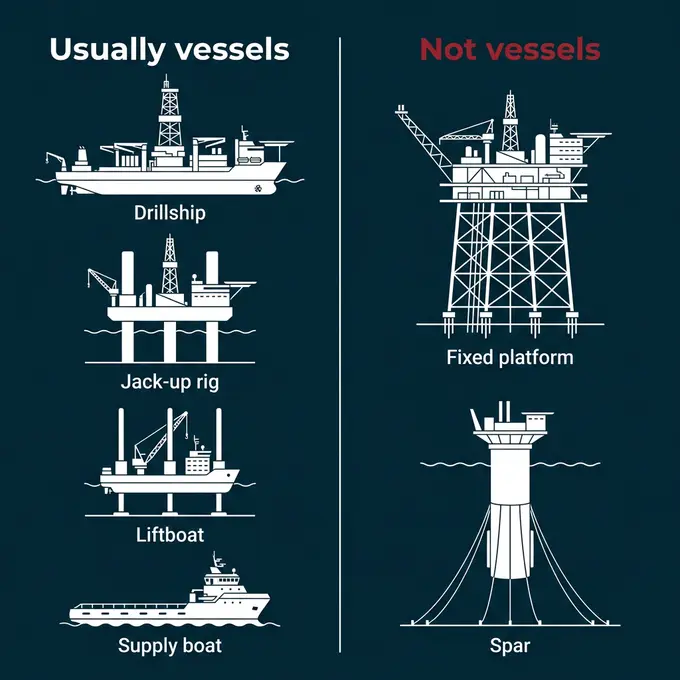
The Jones Act often applies to offshore oil workers on a rig or boat that floats and can move, and it usually doesn’t apply to workers on a fixed platform. Federal courts in Texas and Louisiana generally treat the common offshore structures this way:
- Drillships and semi-submersible rigs. These are generally treated as vessels.
- Jack-up rigs. Jack-up rigs are vessels under federal law in Texas and Louisiana, even while their legs are down and they are standing still to drill.
- Liftboats. Liftboats are generally treated as vessels.
- Crew boats, supply boats and tugs. These are generally treated as vessels, because they are used to carry people and cargo over water, which is how federal law defines a vessel.
- Fixed production platforms, spars and other permanently moored structures. These are not vessels. Courts treat a fixed platform as a man-made island, which means the law treats the platform like land. A floating production structure that is permanently moored, such as a spar, is not a vessel either.
If your rig or boat counts as a vessel, you still have to meet the seaman test for your own job.
If you work on a fixed platform or a spar in federal waters, you’re usually covered by the Longshore Act instead, through the Outer Continental Shelf Lands Act. The Outer Continental Shelf Lands Act is a federal law that extends Longshore Act coverage to workers in offshore oil and gas operations in federal waters. Dock and shipyard workers sent out to a vessel for one job usually aren’t seamen. The Longshore Act usually covers them, because it covers ship repairers and shipbuilders.
Can I sue my employer under the Jones Act?
Yes. If you’re a seaman, you can sue your employer when its negligence helped cause your injury. The law doesn’t list the kinds of injuries it covers. Any injury or illness you got in the course of your work counts, from a fall or a crush injury to a bad back or an illness, as long as your employer’s negligence played a part in causing it. You also have the right to a jury trial. That means a jury of ordinary people can hear the evidence and decide whether your employer was negligent and what you should recover.
Negligence means your employer did something a reasonably careful person would not do, or failed to do something a reasonably careful person would do. On an offshore job, negligence can look like this:
- Equipment that was broken, worn out or unsafe, and that the company didn’t fix or replace
- Too few people on the crew to do the job safely
- No training, or not enough training, for the work you were told to do
- An order to keep working in unsafe conditions
Your employer is responsible for your injury if its negligence played any part, even the slightest part, in causing it. That means the company can still be held responsible even if other things also contributed to your injury.
You can still recover if you were partly at fault for your injury. Your share of the blame reduces the amount you receive, and it does not stop your claim. Expect the company’s insurer to look for ways to put part of the blame on you, because any share of the blame it puts on you lowers what it has to pay. Your employer also can’t avoid responsibility by arguing that you knew the job was dangerous when you took it. The fact that you accepted a risky job does not count against your claim.
If a family member died from an offshore injury, different rules apply, and I explain them on my wrongful death page.
What can I recover under the Jones Act?
A Jones Act claim can pay you for the money you’ve lost and for what the injury has done to your life. If your employer’s negligence helped cause your injury, a jury can award you money for these losses:
- Wages you have already lost because of the injury
- Your reduced ability to earn money in the future
- Medical bills you have already run up, and medical care you will reasonably need in the future
- Physical pain and suffering, past and future, including physical disability
- Mental anguish, past and future, including worry about your financial security
What a claim is worth depends on the facts of your injury. I won’t promise you a number, because no lawyer honestly can. These damages come on top of maintenance and cure, a separate payment for your living and medical costs while you recover.
What is maintenance and cure?
Maintenance and cure is the money your employer owes you for living costs and medical care while you recover from an injury you got while serving on a vessel. Maintenance covers your day-to-day living expenses, such as food and lodging. Maintenance also pays for your travel to and from medical treatment. Cure covers your medical care, including treatment, hospital stays and medicine. If you’re hurt and can’t work, these payments are meant to cover your rent, your food and your treatment while you heal.
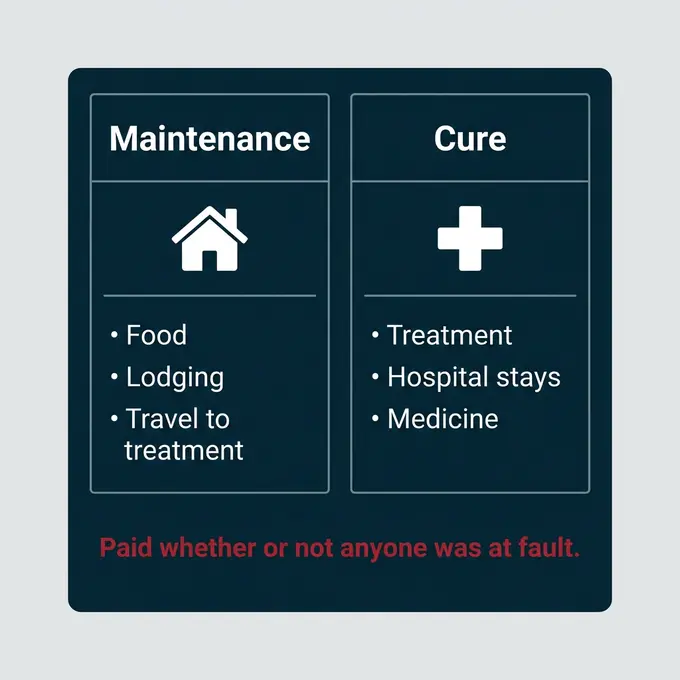
You get maintenance and cure whether or not anyone was at fault for your injury. Even your own carelessness doesn’t take it away. The only thing that can cost you maintenance and cure is misconduct you commit on purpose, which is different from an honest mistake or a careless moment. The payments continue until you reach maximum medical improvement, which is the point when your doctors no longer expect your condition to get any better.
If the company stops paying or pays less than it owes, on purpose and without a good reason, a court can make it pay more than the maintenance and cure itself as a penalty.
What is an unseaworthiness claim?
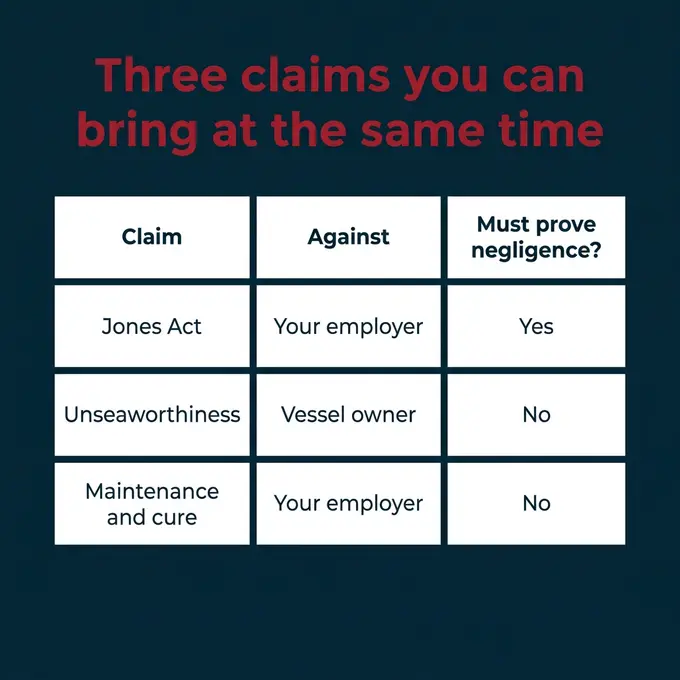
An unseaworthiness claim is a claim for an injury caused by a vessel that wasn’t in good enough condition for its work. You bring it against the owner of the vessel, which can be a different company from the employer you sue under the Jones Act.
The owner has a duty to provide a seaworthy vessel, which means a vessel that is reasonably fit for its intended use. In plain terms, the vessel has to be in good enough condition to do the work it’s used for, with enough crew members who are able to do their jobs. The law calls this duty absolute. That means the owner is responsible for an unfit vessel even if the owner wasn’t careless, so you don’t have to prove that anyone was negligent.
A seaman can bring a Jones Act claim, an unseaworthiness claim and a claim for maintenance and cure at the same time. If your employer was negligent or the vessel was unfit, the Jones Act and unseaworthiness claims can pay for your lost wages, your lost future earnings, your medical care and your pain and suffering.
What is the difference between the Jones Act and workers’ compensation?
The biggest difference is that the Jones Act lets you sue your employer and recover for pain and suffering, while workers’ comp pays set benefits without a lawsuit and doesn’t pay for pain and suffering. If you aren’t a seaman, you may be covered by the Longshore Act or by Texas workers’ comp instead.
| Jones Act | Longshore Act | Texas workers’ comp | |
|---|---|---|---|
| Who it covers | Seamen (vessel crew members) | Offshore and dock workers who aren’t crew | Texas workers whose employer carries comp |
| Do you have to prove fault? | Yes, but your employer’s negligence only has to play a slight part | No | No |
| Can you sue your employer? | Yes, with a jury | No | No |
| What it pays | Lost wages, future earnings, medical, pain and suffering, plus maintenance and cure | Medical, plus two-thirds of your average weekly wage | Medical, plus 70 percent of the weekly wages you lose in most cases |
| Pain and suffering? | Yes | No | No |
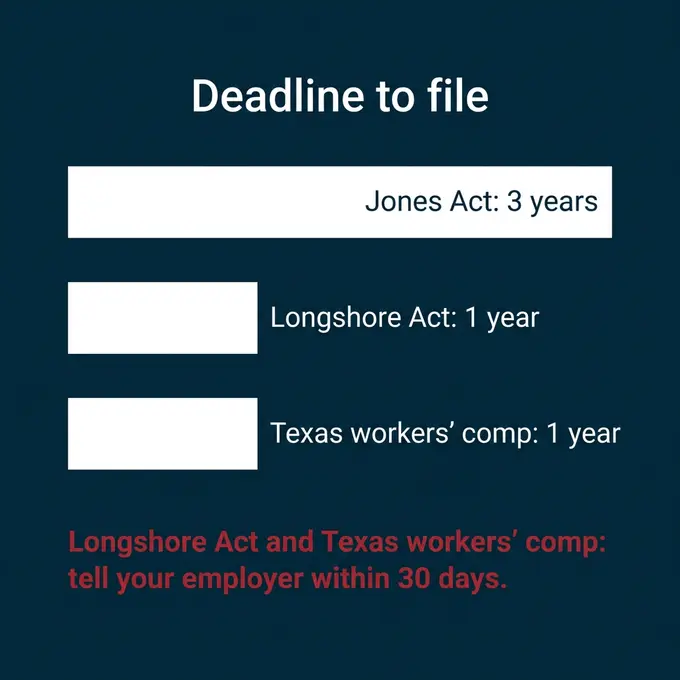
| Deadline to act | 3 years | 30 days to give notice, 1 year to file | 30 days to report, 1 year to file |
If you’re a crew member of a vessel, the Jones Act is the law that covers you. If you work offshore or around the docks but aren’t a crew member, the Longshore Act usually covers you. If you have a land-based job in Texas, Texas workers’ comp usually covers you.
How long do you have to file a Jones Act claim?
You have three years from the day your claim arises to file a Jones Act claim. For most injuries, the three years start on the day you got hurt. The Longshore Act and Texas workers’ comp give you much less time. Under both, you have to tell your employer about the injury within 30 days and file a claim within one year. The Longshore Act requires the notice to be in writing, and Texas workers’ comp has its own claim form. My advice is to act now, before you know for sure which law covers you. If you wait and it later turns out you aren’t a seaman, the one-year deadline may already have passed.
What should I do after an offshore injury?
The steps you take in the first days after an offshore injury protect both your health and your claim. Take them in this order:
- Report the injury and get it in writing. Tell your supervisor or the person in charge as soon as you can. Ask for a copy of the company’s written report of your injury. Then, the same day, write down your own account of what happened. The company writes its report in its own words, so your account is the only record of what happened in your words. Giving your employer written notice also protects you if the Longshore Act or Texas workers’ comp turns out to cover you, because both have a 30-day deadline for telling your employer about the injury.
- Get medical care and tell the doctor plainly what happened. Say that you were hurt at work, and describe how it happened. Your medical records connect your injury to your job, so they should describe what happened at work accurately.
- Don’t give a recorded statement or sign anything from the company or its insurer before you talk to a lawyer. From my time defending insurance companies, I know the insurer starts evaluating your claim right away. A statement you give while you’re hurting, and before you understand your rights, can be used to argue that your injury is minor or that it was your own fault. Because your share of the blame reduces what you can recover, that kind of statement can cost you money.
- Keep your own record. Take photos of where you got hurt and of your injuries. Write down the names of the coworkers who saw it happen. Save your pay stubs, because they show what you were earning before the injury. Save your hitch schedule too, because it shows how much of your working time you spent aboard the vessel.
- Talk to a maritime injury lawyer. Whether you’re a seaman decides which law covers you and what you can recover. A lawyer can look at the facts of your job and tell you which law most likely applies.
Can my employer fire me for filing a Jones Act claim?
Federal law doesn’t directly say whether your employer can fire you for filing a Jones Act lawsuit. The federal law that protects seamen from being fired or punished covers telling the vessel owner or the Coast Guard about a work-related injury or illness. It also covers reporting a safety violation to the Coast Guard and cooperating in a safety investigation. It covers refusing dangerous work too, but only if you asked the company to fix the problem first. Filing a lawsuit is not on that list. That means reporting your injury is clearly protected, and the lawsuit itself is a question to ask a lawyer about. If you’re fired, threatened or pressured after you report an injury or bring a claim, write down what was said, who said it and when. Then talk to a lawyer before you quit or sign anything.
Do I need a lawyer for a Jones Act claim, and what does it cost?
The law doesn’t require you to have a lawyer for a Jones Act claim. Whether you count as a seaman and what your claim is worth both depend on evidence about your job and your injury. A lawyer who handles maritime injuries knows what evidence those questions need and how to gather it. So you don’t have to hire a lawyer, but you’ll probably be better off with one.
I work on contingency, which means you pay nothing up front and I’m paid only if I win your case. My fee is 33 percent if your case settles before a lawsuit is filed, 40 percent if a lawsuit is filed, and 45 percent if the case goes to appeal. If I don’t win, you don’t owe me a fee. I explain more about how personal injury lawyer fees work in Houston in a separate post.
When you hire me, you get me. That means you’ll have my cell phone number, and when you have a question about your case, you can call me and talk to me about it.
If you were hurt offshore or on a vessel in the Gulf, I’d like to hear what happened. The consultation is free. You can call any hour of the day, any day of the week, and a real person will answer. Contact me, and I’ll look at your job, your vessel and your injury and tell you whether I think the Jones Act covers you. If it turns out you aren’t a seaman, I also handle other workplace injury cases, and I’ll tell you what your options are.
About the author. I'm Jeffrey N. Todd, a Texas attorney. I've practiced law since 2000 and founded my Houston practice, Jeff Todd, Personal Injury Attorney, in 2018. My office is at 12929 Gulf Freeway, Suite 301, Houston, TX 77034, and my phone number is (832) 243-4953. I serve injured people across the greater Houston area, including Galveston and the Gulf Coast. Reviewed by Jeff Todd on October 5, 2026.
This article is general information about the Jones Act and maritime injury law, not legal advice about your situation, and reading it does not create an attorney-client relationship. Every case is different. See the full disclaimer.