

After a truck accident in Texas, get to safety and call 911, get medical care the same day, photograph the truck’s USDOT number and company name, and do not discuss fault or give a recorded statement to the trucking company’s insurer. Report the crash to your own insurer, get your Texas crash report, and have a lawyer send a preservation letter fast, because the trucking company can lawfully discard driver logs after six months and inspection reports after three. You generally have two years to file an injury or wrongful death lawsuit in Texas, and far less time if a government vehicle was involved.
I’m Jeff Todd, a Houston personal injury attorney. Before I started representing injured people, I spent years on the insurance-defense side, working for the same kind of companies I now bring claims against. I know what happens inside an insurance company in the hours after a serious wreck. Each step here is ordered by what protects you, and with each one I’ll tell you what the trucking company’s side will try to do with it.
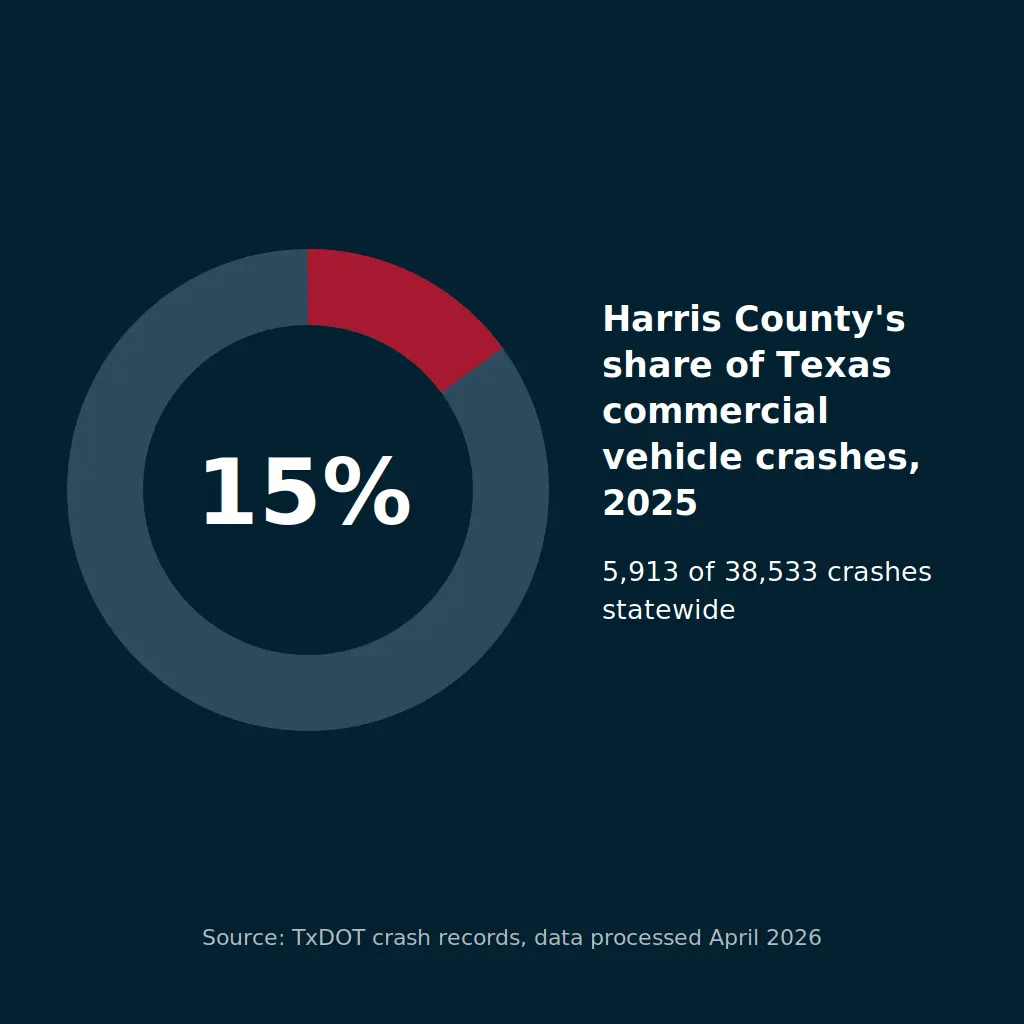
Texas has more large trucks involved in fatal crashes than any other state. In 2024, 699 large trucks in Texas were involved in fatal crashes, according to the National Highway Traffic Safety Administration. TxDOT counted 38,533 crashes involving commercial motor vehicles in Texas in 2025, with 528 deaths, in data processed as of April 2026. Harris County alone had 5,913 of those crashes and 43 deaths. If you drive I-45, I-10, the 610 Loop, or Beltway 8, you share the road with port traffic every day.
Key Takeaways
- Call 911 for any crash with injuries. The officer’s report is the first neutral record of who the trucking company is.
- See a doctor the same day and tell the provider you were hit by a commercial truck.
- Photograph the USDOT number, the company names on the cab and trailer, both license plates, and the scene.
- Don’t discuss fault at the scene and don’t give a recorded statement to the trucking company’s insurer.
- The most important evidence sits in the trucking company’s files, and federal rules let the company discard some of it on a schedule. A preservation letter stops that.
- Most Texas injury and wrongful death lawsuits must be filed within two years. Claims against the City of Houston require written notice within 90 days.
Step 1: Get to Safety and Call 911
Texas law requires every driver in a crash involving injury or death to stop, check on the other people involved, and report it to police. Under Texas Transportation Code Chapter 550, you must notify police or the sheriff immediately if anyone is hurt or killed, or if a vehicle can’t be driven safely. Leaving the scene of a crash that causes serious injury or death is a felony.
If your car still runs and you are on a freeway, Texas law also expects you to move it out of the travel lanes when you can do so safely. Do that, then call. Tell the dispatcher where you are, that a commercial truck or 18-wheeler was involved, and whether anyone is hurt. Ask for an ambulance if there is any doubt.
The officer matters more in a truck crash than in a fender-bender between two cars. The crash report is the first neutral record of who was driving, which company operated the truck, what insurer covered it, and what the scene looked like before everyone left. The trucking company’s people will build their own version of events, so you want a neutral record made before anyone leaves the scene.
Step 2: Get Medical Care the Same Day
See a doctor the day of the crash, even if you feel fine. Adrenaline hides pain, and some injuries take time to show. The CDC notes that concussion symptoms can appear hours or days later, and that a worsening headache, repeated vomiting, confusion, slurred speech, or weakness on one side calls for emergency care. Whiplash and internal bleeding can follow the same delayed pattern.
Adjusters look for gaps in treatment. When an adjuster opens a file, one of the first things they check is the time between the crash and the first medical visit. A week with no treatment becomes their argument that you weren’t really hurt, or that something else caused the injury. Same-day care takes that argument away from them.
When you see the provider, say plainly that you were in a crash with a commercial truck. That sentence goes into your chart, and your chart becomes evidence. Same-day treatment also carries weight in a truck case that it doesn’t in an ordinary car wreck. Under 49 CFR 382.303, one of the conditions that can require the truck driver to be tested for drugs and alcohol after a crash is that someone was hurt badly enough to receive medical treatment away from the scene right away. Your documented treatment can help show that condition was met.
Step 3: Collect What You Can at the Scene
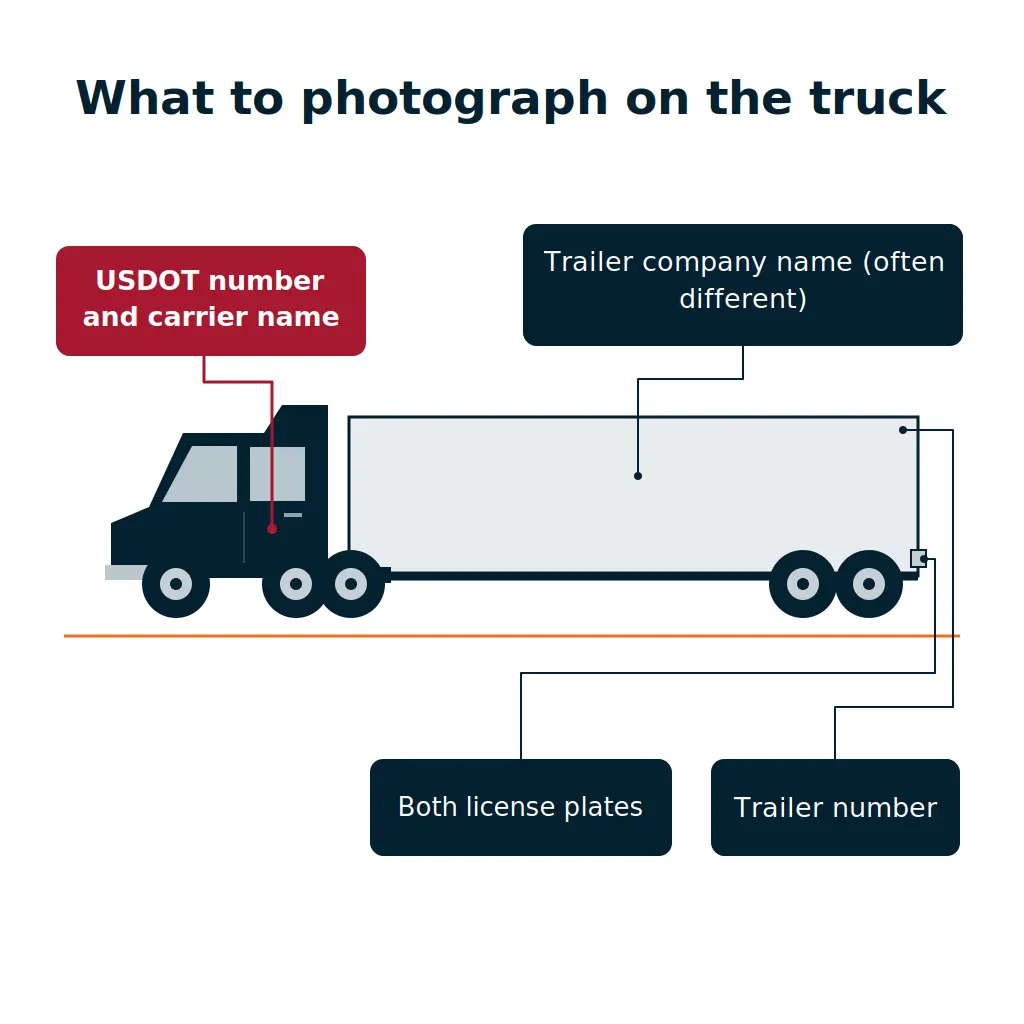
If you are hurt, skip this step or hand your phone to a passenger or family member. Safety and medical care come first. If you can move around safely, photograph these before anything gets cleaned up:
- The USDOT number on the truck’s door. Federal rules under 49 CFR 390.21 require the operating carrier’s name and USDOT number on both sides of the truck.
- The company name on the cab and the company name on the trailer. They are often different, and that tells you there may be more than one company involved.
- The MC number if you see one. It isn’t required on every truck, so don’t worry if it’s missing.
- The trailer number and both license plates.
- The driver’s commercial driver’s license and the carrier’s insurance information. Texas law requires a driver to show proof of financial responsibility to anyone else involved in the crash.
- Skid marks, the debris field, damage to both vehicles, the road, traffic signals, and the weather.
- Names and phone numbers of every witness. People leave fast.
Once you have the USDOT number, you can look the company up for free on the FMCSA’s SAFER system. It shows the carrier’s size, inspection history, and crash record. It won’t tell you who was at fault in your crash, but it tells you who you are dealing with.
Step 4: Don’t Discuss Fault and Don’t Give a Recorded Statement
Say nothing about fault to anyone at the scene, including the truck driver, and do not give a recorded statement to the trucking company’s insurer. Give the officer the facts. Tell the truck driver you are calling 911. That is all the conversation you need.
Serious truck crashes get a fast response from the other side. In my years defending insurers, I watched carriers and their claims services send adjusters and investigators to a scene within hours, sometimes with a defense attorney. They photograph, they interview, and they start building the file before the injured person has left the emergency room. Claims-services companies openly market this kind of rapid deployment to trucking fleets. It is standard practice, and it is legal.
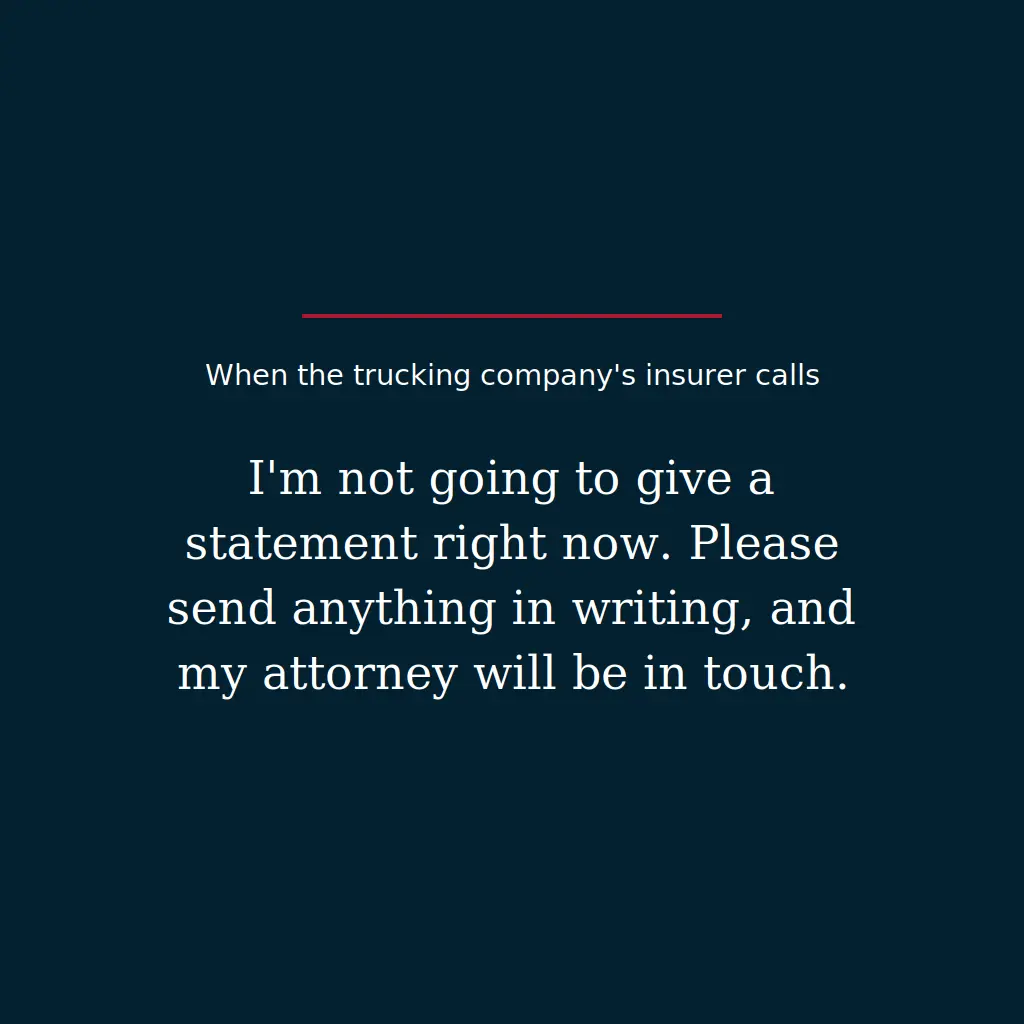
Then the phone call comes. A friendly adjuster wants to “check on you” and “get your side of the story” on a recorded line. That call is evidence gathering. Anything you say about how you feel (“I’m okay, just sore”) or what happened (“I didn’t see him until the last second”) will be quoted back to you later. You can decline, and you should. Something like this works:
“I’m not going to give a statement right now. Please send anything in writing, and my attorney will be in touch.”
Your own insurance company is a different matter. Your policy requires you to cooperate with your own insurer, and you should. The line I’m drawing is with the trucking company’s side.
Step 5: Report the Crash to Your Own Insurer
Call your own auto insurer and report the crash, even if the truck driver was clearly at fault. The Texas Department of Insurance advises this, and it protects coverage you may need.
Know what your policy includes. Under Texas law, auto policies must include personal injury protection (PIP) and uninsured/underinsured motorist coverage (UM/UIM) unless you rejected them in writing. PIP pays medical bills and a portion of lost income regardless of fault, with a required minimum of $2,500 under Texas Insurance Code Chapter 1952. Many people carry more without knowing it. UM/UIM steps in if the responsible party’s coverage isn’t enough, which can matter when a smaller carrier is involved. Pull out your declarations page and read it.
Step 6: Get Your Texas Crash Report
When a crash involves injury, death, or apparent damage of $1,000 or more, the investigating officer files a Texas Peace Officer’s Crash Report (form CR-3) with TxDOT within ten days. You can buy a copy through TxDOT’s Crash Report Online Purchase System for $6, or $8 for a certified copy, plus processing fees. Ask the officer for the report number at the scene so you can find it.
Timing varies. Local agencies typically quote anywhere from several days to about two weeks before a report is available. I put together a walkthrough on how to request your Texas crash report, including what to do if it hasn’t shown up yet.
Read it when you get it. Check the driver’s name, the carrier’s name, the insurance information, the diagram, and the officer’s narrative. Errors happen, and they are easier to fix early.
Step 7: Preserve the Evidence the Trucking Company Controls
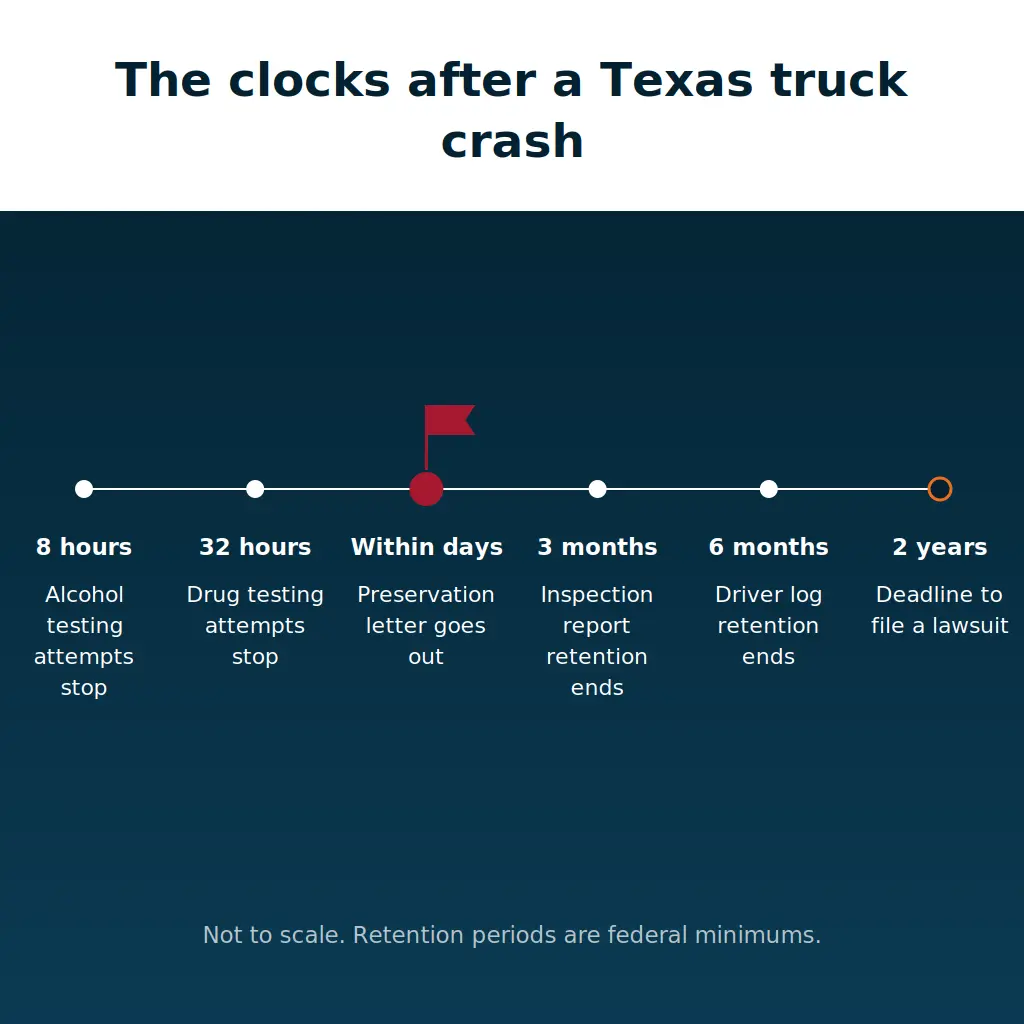
This is the step that separates a truck crash from a car crash, and it is the one people miss. In a car wreck, most of the evidence is at the scene or in your hands. In a truck wreck, the most important evidence sits in the trucking company’s files and on the truck itself, and federal rules let the company get rid of some of it on a schedule.
Here is how long a trucking company must keep each record under the Federal Motor Carrier Safety Regulations, and what each one shows:
| Record | What it shows | Minimum retention |
|---|---|---|
| Electronic logging device (ELD) and hours-of-service records | How long the driver had been on duty, whether they were over hours | 6 months (49 CFR 395.8) |
| Driver vehicle inspection reports | Defects the driver flagged before and after trips | 3 months (49 CFR 396.11) |
| Maintenance records | Brake, tire, and repair history | 1 year while the truck is in service (49 CFR 396.3) |
| Annual inspection report | Whether the truck passed its yearly inspection | 14 months (49 CFR 396.21) |
| Driver qualification file | Hiring records, driving history, medical certification | Employment plus 3 years (49 CFR 391.51) |
| Post-crash drug and alcohol test results | Whether the driver was tested and what it showed | Positive results and refusals 5 years, negatives 1 year (49 CFR 382.401) |
| Accident register | The carrier’s own record of the crash | 3 years (49 CFR 390.15) |
Those are minimums for the carrier’s ordinary recordkeeping. Once the six months on the driver’s logs run out, nothing in the rules requires the company to keep them another day. The engine control module (the “black box”), dashcam video, telematics, dispatch records, and bills of lading have no single federal retention rule at all, which means they can be overwritten in the normal course of business unless someone tells the company to stop.
Drug and alcohol testing runs on an even shorter clock. Under 49 CFR 382.303, a fatal crash requires testing of the driver. A crash with injuries or a tow-away requires testing only if the driver is cited. Either way, alcohol testing attempts stop after 8 hours and drug testing after 32. If the test wasn’t done in that window, it never will be.
What a Preservation Letter Does
The tool that stops the clock is a preservation letter, sometimes called a spoliation letter. It goes to the carrier, the driver, the insurer, and anyone else who may hold evidence, and it puts them on notice that a claim is coming and that the listed evidence must be kept. Under the Texas Supreme Court’s decision in Brookshire Bros. v. Aldridge, a company’s duty to preserve evidence begins when it knows or should know there is a substantial chance of a claim. A company that quietly follows its normal deletion schedule before anyone puts it on notice may face no penalty at all. A company that destroys evidence after receiving the letter is in a very different position.
That is why I send these letters within days of taking a truck case, not weeks. The drug-test window closes in a day and a half. Inspection reports can be gone in three months. The other side already has this evidence, and every week that passes before a preservation letter goes out is a week in which some of it can lawfully disappear.
Step 8: Keep a Simple Record and Stay Off Social Media
Start a notebook or a note on your phone the day of the crash. Write down:
- Your symptoms each day, including pain levels and anything new.
- Every medical appointment, with mileage to and from.
- Days and hours of work you missed.
- Out-of-pocket costs: prescriptions, braces, rides, help around the house.
- The name, company, and number of everyone who calls you about the crash.
Then stay off social media about the crash and your recovery. Don’t post photos of the wreck, updates on how you feel, or a picture from your cousin’s barbecue two weeks later. Adjusters and defense attorneys look at public profiles, and a photo of you smiling at a party will be used to argue that you weren’t in pain. Give them nothing to work with.
Step 9: Know Your Texas Truck Accident Deadlines
Texas gives you two years from the date of the crash to file a personal injury lawsuit, and two years from the date of death for a wrongful death lawsuit, under Texas Civil Practice and Remedies Code Section 16.003. Limited exceptions exist, but don’t count on one applying to you.
The two-year rule is the long deadline. Shorter ones apply when a government vehicle or government entity is involved, and they catch people by surprise:
| Situation | Deadline |
|---|---|
| Injury or wrongful death lawsuit against a private trucking company | 2 years |
| Claim against a Texas state or local government unit (Texas Tort Claims Act) | Written notice within 6 months (CPRC Section 101.101) |
| Claim against the City of Houston | Verified written notice within 90 days under the city charter (City of Houston claim process) |
| Crash with a federal government vehicle | Written administrative claim within 2 years, then suit within 6 months of a final denial (28 U.S.C. 2401) |
If a city truck, a METRO bus, a school district vehicle, or a state-owned truck was involved, the notice deadline can run out before you have even finished physical therapy. Texas courts enforce Houston’s 90-day rule as written, and the Texas Supreme Court held in City of Houston v. Torres that the charter has no good-cause exception for missing it. Don’t count on the city’s own crash records to excuse a late notice.
Even with a private carrier and the full two years, waiting is a mistake in a truck case. Filing on time is only part of it. The evidence in Step 7 is disappearing on its own schedule, witnesses move, and the carrier’s file is getting thicker while yours stays thin. A case filed in month 23 is a weaker case than the same facts handled in week two.
Step 10: Decide Whether You Need a Truck Accident Lawyer, and When
I’ll tell you the same thing on the phone that I’ll tell you here. If a box truck tapped your bumper in a parking lot and nobody was hurt, you probably don’t need me, and I’ll say so. Handle it through insurance and get on with your life.
A crash with an 18-wheeler that put someone in the hospital is a different situation, and in my experience it is almost always one where you should talk to a lawyer before you talk to the trucking company’s insurer.
The policies are large. Federal rules under 49 CFR 387.9 require most for-hire interstate carriers hauling general freight to carry at least $750,000 in liability coverage, and the minimum climbs to $5 million for the most hazardous cargo. Those are minimums the carrier must carry, and they say nothing about what any particular case is worth. The FMCSA itself has said the minimums were set in the 1980s. What they tell you is that the insurer has a lot at stake and will defend the file accordingly.
There are usually several potential defendants. The driver, the carrier, the owner of the trailer if it’s a different company, the shipper or broker who arranged the load, and the maintenance contractor can each have a role, and each has its own insurer and its own lawyers. Whether any of them is actually liable depends on the facts. Sorting out who controlled what is investigative work, and it has to happen early.
The other side started at the scene. By the time most people call me, the carrier’s investigator has already photographed the truck, interviewed the driver, and pulled the electronic logs. A lawyer’s first week on a truck case is spent catching up: sending preservation letters, identifying every carrier and insurer connected to the truck, pulling the SAFER data, requesting the crash report and any 911 audio, and getting your medical care documented properly. You can do some of that alone. You can’t do all of it from a hospital bed.
My fee is a contingency fee: 33% of the recovery if your case settles before a lawsuit is filed, 40% if I file suit, and 45% if the case goes to appeal. You pay nothing up front, and there is no fee unless I win. I wrote more about how personal injury lawyer fees work in Houston if you want the details. You can also read more about how I handle Houston truck accident cases.
How Truck Accident Claims Differ From Car Accident Claims in Texas
An 18-wheeler or commercial truck crash is a car accident case with several extra layers, and each layer favors the side that moves first.
Federal rules apply. Commercial carriers operate under the Federal Motor Carrier Safety Regulations: hours-of-service limits, drug and alcohol testing, driver qualification standards, and maintenance requirements. A violation of one of those rules can be evidence of negligence in a way that has no equivalent in a two-car collision.
The evidence belongs to the defendant. Logs, inspection reports, telematics, and dispatch records are all in the carrier’s possession, and Step 7 explains how quickly they can disappear.
More defendants, more insurers. Layered coverage means more adjusters, more defense attorneys, and more finger-pointing between companies about who was responsible for the driver, the truck, and the load.
Texas trial rules for commercial vehicles. Since 2021, a trucking defendant in Texas can ask the court to split the trial into two phases under CPRC Chapter 72, with liability and compensatory damages decided first and punitive damages second. If the company admits the driver was its employee acting within the job, some claims about the company’s own hiring and training conduct can be kept out of the first phase. Independent claims, such as negligent maintenance, are preserved. It changes how a case is built, and it rewards lawyers who know the rule.
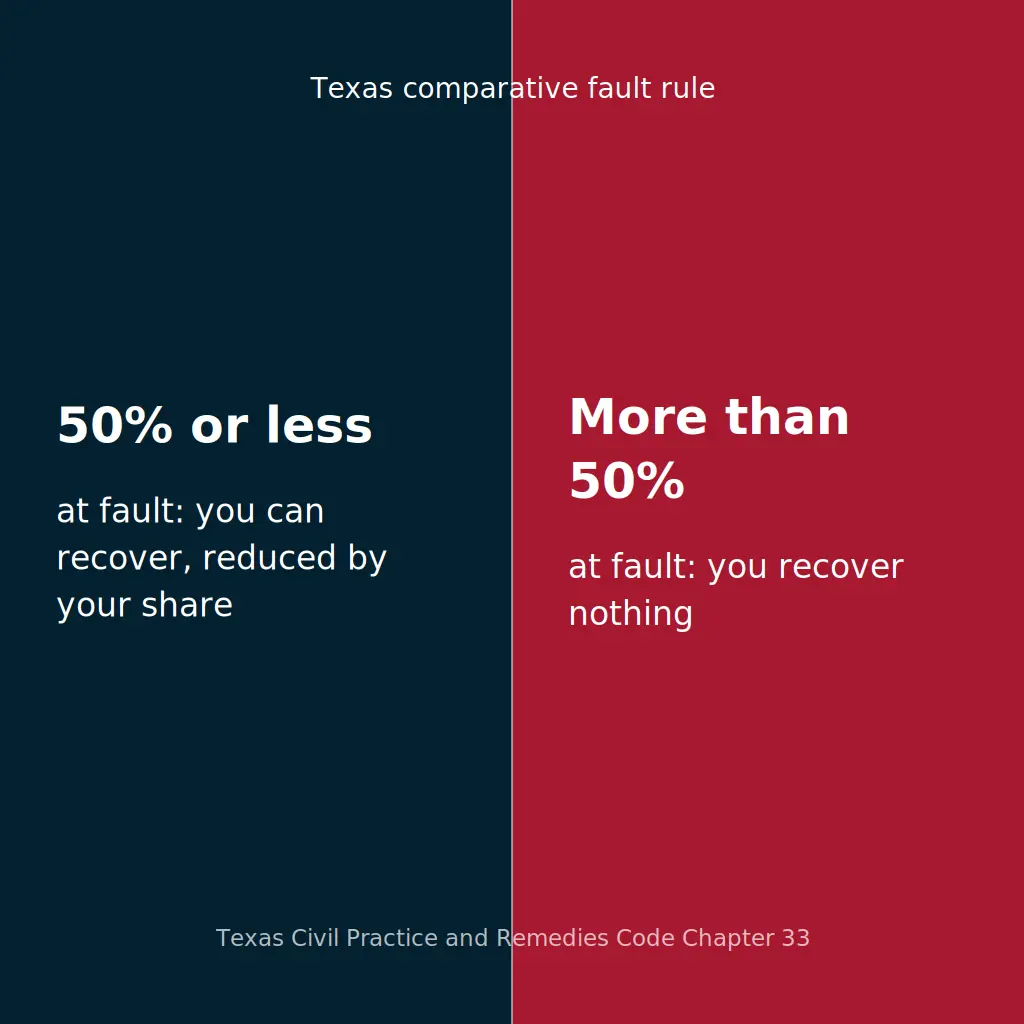
Comparative fault. Texas follows a modified comparative fault rule under CPRC Chapter 33. If you are found more than 50% responsible, you recover nothing. If you are 50% or less responsible, your recovery is reduced by your percentage. The carrier’s adjuster knows this, and pushing a share of the fault onto you is one of the first things they will try. Every statement you make in Step 4 is measured against that goal.
Texas Truck Accident FAQs
How long do I have to file a truck accident lawsuit in Texas?
Two years from the date of the crash for an injury claim, and two years from the date of death for a wrongful death claim. If a government vehicle was involved, written notice deadlines can be as short as 90 days in Houston and 6 months for state and other local government units.
Should I talk to the trucking company’s insurance adjuster?
Not on a recorded line, and not before you understand your injuries. Take their name and number, ask them to put any request in writing, and let your attorney handle the conversation. Your own insurer is different, and you should report the crash to them promptly.
What if I was partly at fault for the truck accident?
You can still recover in Texas as long as you were not more than 50% responsible. Your recovery is reduced by your share of the fault. Because of this rule, expect the carrier’s insurer to argue that you were speeding, distracted, or in the truck’s blind spot. Don’t help them make that case.
What if the truck driver was working for a company out of state?
You can generally still bring your claim in Texas when the crash happened here. Interstate carriers are registered with the FMCSA and must keep proof of insurance at their principal place of business. The USDOT number you photographed in Step 3 is how you identify the carrier no matter where it’s based.
What if I was driving for work when the truck hit me?
You may have two claims: a workers’ compensation claim through your employer’s carrier, and an injury claim against the trucking company. Texas law allows both at the same time under Labor Code Chapter 417, and the comp carrier gets reimbursed from the third-party recovery. I handle the injury claim against the trucking company. I don’t handle the workers’ compensation claim itself, and the two need to be coordinated before any settlement. If you were hurt on the job, my workplace accident page has more.
How much does a truck accident lawyer cost in Texas?
I work on contingency, which is how most injury lawyers handle these cases. My fee is 33% of the recovery before a lawsuit is filed, 40% after suit is filed, and 45% on appeal. There are no upfront costs and no fee unless I win.
How long does a truck accident case take in Texas?
Injury cases often run a year or more, and longer once a lawsuit is filed. In my experience, truck cases run toward the longer end because there are usually several defendants and insurers, and each one has its own adjusters and lawyers. Your treatment also has to run its course before anyone can say what the injury actually cost you.
How much is a truck accident case worth in Texas?
I won’t quote you a number, and you should be wary of anyone who does before looking at your file. Every case is different, and results can’t be guaranteed. What drives the value is the severity and permanence of the injury, how fault gets divided under the 50% rule, how many layers of insurance are in play, and your lost earnings. I can give you a candid read on those factors once I’ve seen your records.
What if a family member was killed in a truck accident?
Texas allows certain family members to bring a wrongful death claim, and the two-year clock runs from the date of death rather than the date of the crash. The evidence and deadline issues in this article apply with even more force, because the trucking company’s response to a fatal crash is immediate. My wrongful death page explains how these cases work.
Talk to Me Before You Talk to the Trucking Company
If you or someone in your family was hit by a commercial truck anywhere in the Houston area, call me. A live person answers the phone any hour of the day, and I call back personally. The consultation is free, and I’ll tell you straight whether you need a lawyer. If you do, I’ll get the preservation letters out while the evidence still exists. When you hire me, you get me, including my cell number.
Contact me or call (832) 243-4953. My office is at 12929 Gulf Freeway, Suite 301, Houston, TX 77034, near the I-45 and Beltway 8 interchange. Trust Jeff.
About the author. Jeff Todd is a Houston personal injury attorney licensed in Texas since 2000. He spent the early part of his career on the insurance-defense side before switching to represent injured people, and founded his own firm in 2018. He handles every case personally. Last reviewed September 30, 2026.
This article is general information about Texas truck accident claims, not legal advice about your situation, and reading it does not create an attorney-client relationship. Every case is different. See the full disclaimer.