

Most personal injury cases in Texas start as an insurance claim, and in my experience, most of them settle. You file a lawsuit when the insurance company won’t pay a fair amount. Most lawsuits then move through four steps:
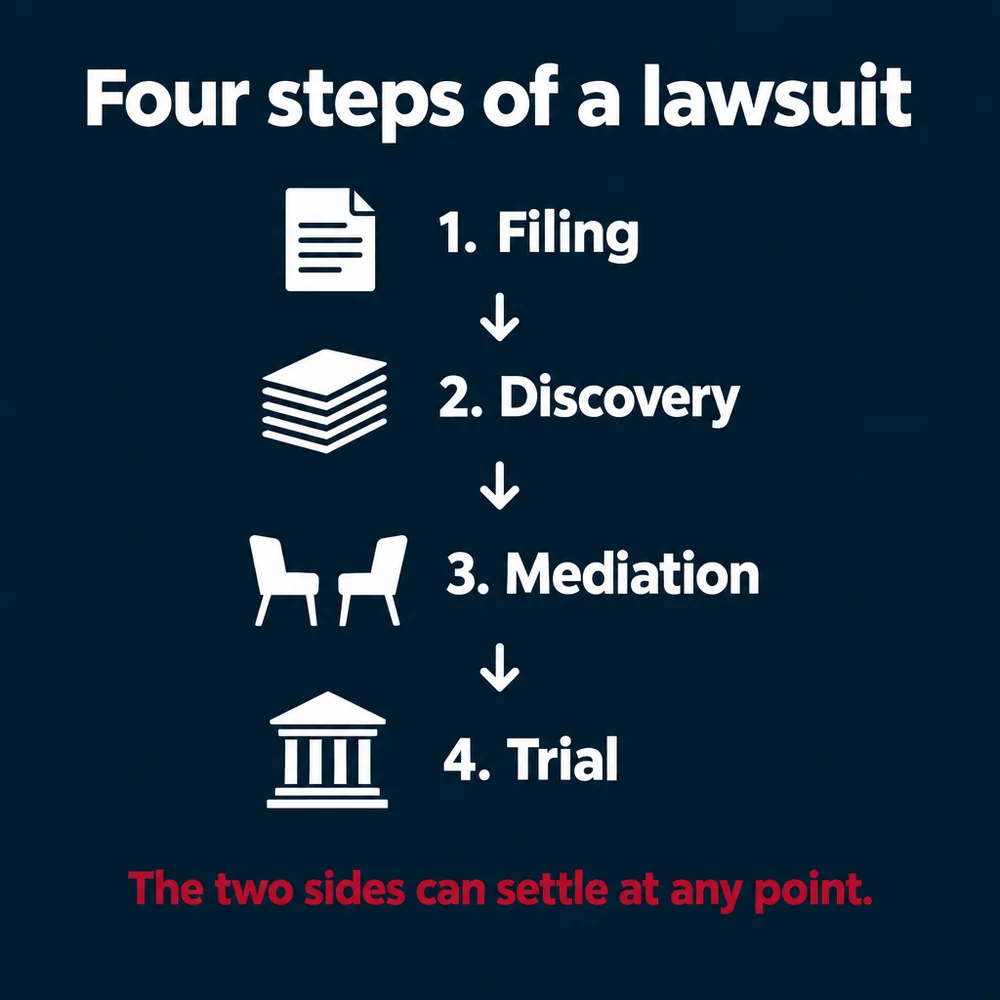
- Filing: I file the lawsuit with the court and have a copy formally delivered to the person or company that hurt you.
- Discovery: each side gets to see the other side’s evidence, and you answer the defense lawyer’s questions under oath, first in writing and then in person.
- Mediation: both sides meet with a neutral person to try to settle.
- Trial: if the case still hasn’t settled, a judge or jury decides it.
The two sides can settle at any point along the way.
A personal injury case often takes a year or more to resolve, and filing a lawsuit can add another one to two years. How long yours takes depends on how long your treatment lasts, how busy the court is, and how soon the insurance company is willing to make a fair offer.
I’m Jeff Todd, a Houston personal injury attorney, and I’ve practiced law for about 25 years. I spent the early part of my career defending insurance companies before I started representing injured people, so I’ve seen this process from both sides.
Before the lawsuit: the insurance claim
Once you hire me, I gather the evidence about how you got hurt, collect your medical records and bills, and document everything the injury has cost you. Your job during this time is to get the medical care you need and keep going to your appointments.
When the evidence is in, I send the insurance company a demand. A demand is a package that lays out what happened, what your injuries are, what they’ve cost you so far and what they’ll cost in the future, and the amount you’re asking for to settle. A demand usually works best once your doctors can say what your treatment and future care look like, because before then nobody knows the full cost of your injury. After the demand goes out, the insurance company makes an offer, and we negotiate. You’ll find more on how this works after a crash on my Houston car accident attorney page.
Do you have to file a lawsuit?
You only need to file a lawsuit when the insurance company won’t offer a fair amount or won’t deal with your claim at all. Filing is a normal next step, and it gives the insurance company a reason to take your claim seriously. Before a lawsuit, there’s no court schedule pushing the insurance company’s adjuster (the employee who handles your claim) to move your claim along. After a lawsuit is filed, a judge sets the schedule, and the insurance company knows the case could go to trial in front of a jury if it doesn’t settle.
A lawsuit is filed against the driver or the property owner who hurt you. When they have insurance, though, the insurance company decides whether to settle and for how much. It usually hires and pays their lawyer, and it pays any settlement. I spent years on that side, so I know how insurance companies decide what to offer. One thing they weigh is whether the lawyer across the table will actually go to trial. They know I will take a case to a jury when a fair offer doesn’t come, and that’s part of why most of my cases settle.
I work on contingency, so you pay nothing up front and owe no fee unless I win. My fee is 33% if your case settles before a lawsuit is filed, 40% if a lawsuit is filed, and 45% if the case goes to appeal. It rises because a lawsuit takes far more work. I explain the fee and case expenses in detail in how much a personal injury lawyer costs in Houston.
How long do you have to file a personal injury lawsuit in Texas?
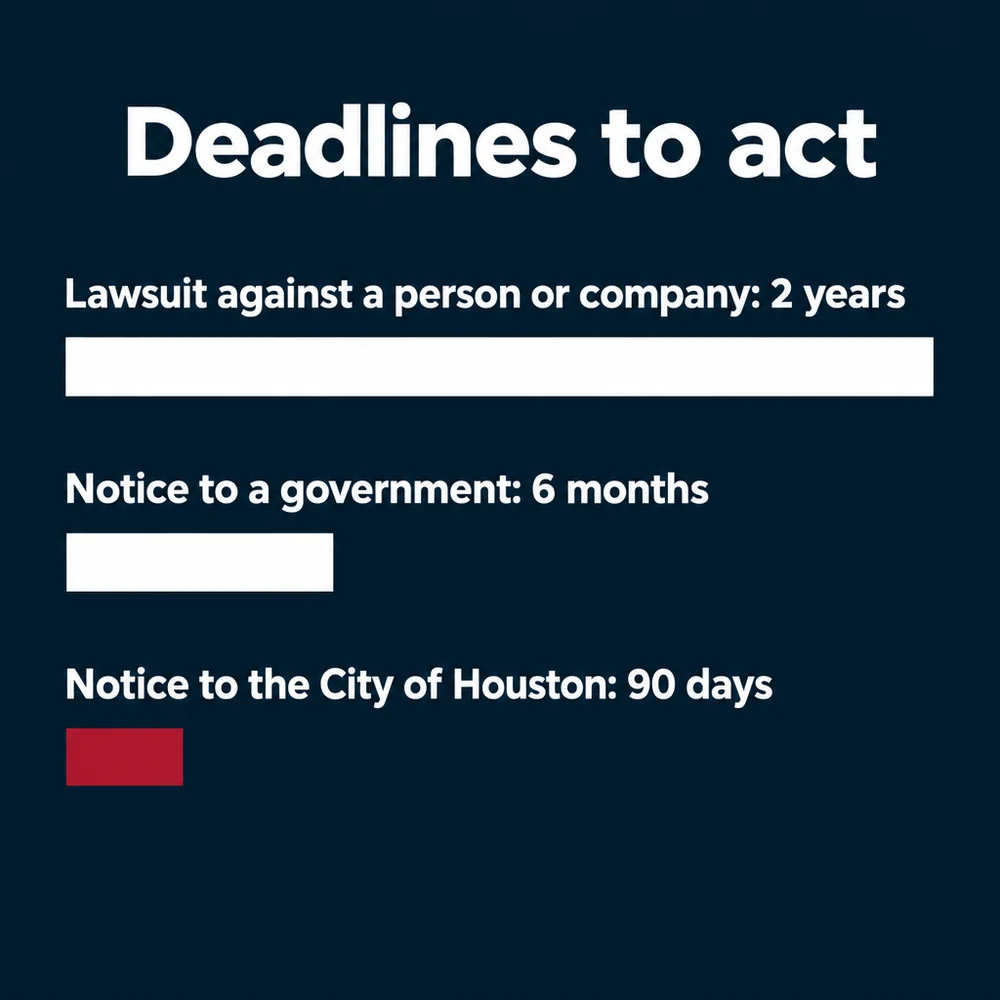
In Texas, you generally have two years from the day you were hurt to file a personal injury lawsuit. If you miss that deadline, you will usually lose the right to sue, no matter how strong the case is. That’s why talks with the insurance company can’t go on forever: if the claim hasn’t settled as the deadline gets close, the lawsuit has to be filed.
You have much less time when a government caused your injury, such as a city bus, a county truck or a state agency. Before you can sue a government in Texas, you or your lawyer have to give it notice of your claim that describes your injury and when, where and how it happened. That notice is due within six months of the incident. Claims against the City of Houston have an even shorter deadline: written notice is due within 90 days after the injury. If a City of Houston vehicle or property hurt you, the 90-day deadline is the one to meet. In any case involving a government, talk to a lawyer right away.
Step 1: Filing the petition and serving the defendant
A Texas personal injury lawsuit begins when I file a petition with the court. The petition is the document that names you as the plaintiff and the person or company that hurt you as the defendant, describes what happened, and states what you’re asking for.
The defendant then has to be formally notified, which is called service. A copy of the petition goes to the defendant along with a court notice saying they’ve been sued. In Harris County, service can be handled by a constable or by certified mail. You don’t need to do anything during this step.
Once served, the defendant has about three weeks to file an answer, which is their written response to the lawsuit (Tex. R. Civ. P. 99). The lawyer the insurance company hired usually files it.
Step 2: Discovery
Discovery is the stage where each side has to share its evidence with the other, and your part in it is answering questions under oath, first in writing and then in person at a deposition. It is usually the longest part of a lawsuit. In most cases, Texas rules allow discovery to run up to about nine months (Tex. R. Civ. P. 190).
What will you have to do in discovery?
The defense lawyer will send you three kinds of written requests, and you have 30 days to respond to each one (Tex. R. Civ. P. 196, 197 and 198):
- Interrogatories: written questions that you answer under oath, about your injuries, your medical history, your work and how the accident happened.
- Requests for documents: things like medical bills, records and pay stubs.
- Requests for admission: statements that you either admit or deny. Anything you admit counts as proven for the rest of the case, unless the court lets you take it back.
I prepare the responses with you, because your answers have to be accurate and complete. Both sides also have to share some basic information without being asked, including all medical records and bills related to your injuries (Tex. R. Civ. P. 194). That’s why I need to know early on about every doctor, hospital and pharmacy you’ve used.
What happens at your deposition?
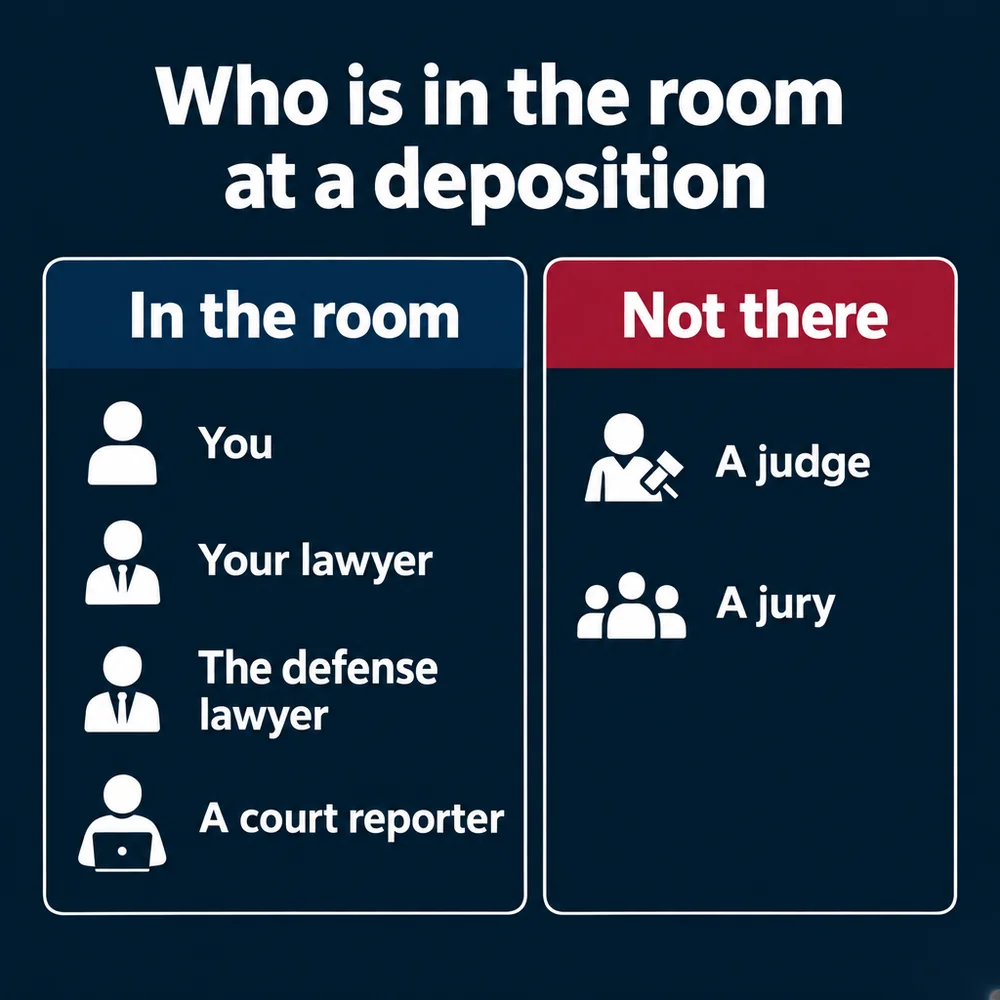
A deposition is an interview under oath, and the defense lawyer will almost certainly ask to question you in one. It usually happens in a lawyer’s office or a conference room, not a courtroom, and there’s no judge or jury. In the room are you, me, the defense lawyer, and a court reporter who swears you in and types every word. Sometimes it’s also recorded on video.
The defense lawyer will ask about your background, your health before the accident, how the accident happened, your injuries and treatment, and how your life and work have changed since. Your job is to listen to each question, answer only that question, and tell the truth. If you don’t know or don’t remember, that’s the answer. I go over what to expect with you before the day comes, and I sit next to you during the deposition.
Other people get deposed too, such as the other driver, witnesses and sometimes your doctors. I question them, and you usually don’t need to be there.
Smaller cases: expedited actions under $250,000
If you ask for $250,000 or less, your case goes on a faster track called an expedited action, with shorter discovery and the option of a trial date soon after discovery ends (Tex. R. Civ. P. 169). The catch is that the court can’t award you more than $250,000 plus interest, even if a jury awards more, so it only makes sense when your damages are clearly below that amount, and it’s a decision we’d make together.
Step 3: Mediation
Mediation is a meeting where both sides try to settle the case with help from a neutral person called a mediator. Many courts put mediation in the case schedule, often after discovery. A judge can order mediation even if neither side asks for it (Tex. Civ. Prac. & Rem. Code § 154.021). The two sides can also choose to mediate without an order.
You attend mediation with me. The two sides often sit in separate rooms, with the mediator going back and forth carrying offers. Some courts, such as one Harris County court in its mediation instructions, require the insurance company to send someone who has the authority to agree to a settlement.
The mediator can’t make anyone settle (§ 154.023). Nothing settles unless you agree to it. What’s said at mediation is also confidential and can’t be used as evidence later (§ 154.073), which lets both sides talk openly about the weak points in their own case. If it doesn’t settle at mediation, the case stays on the court’s schedule for trial, and the two sides can keep negotiating until the trial starts.
Step 4: Trial
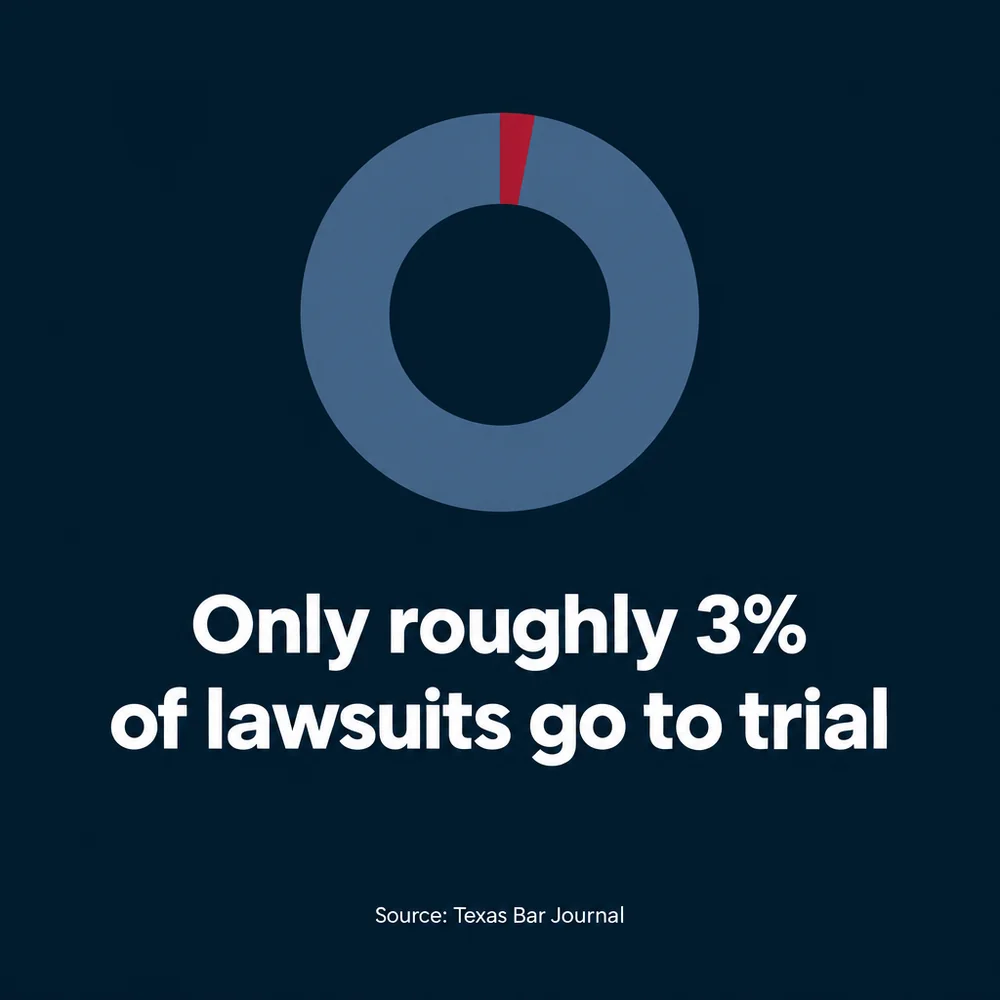
Very few lawsuits reach a trial. In an article in the Texas Bar Journal, the authors note that “only roughly 3% of lawsuits go to trial,” and they add that most of the rest settle.
What happens at a personal injury trial?
If your case is tried in front of a jury, the trial follows a set order:
- The lawyers pick the jury.
- Each side gives an opening statement.
- The witnesses testify, and each side shows the jury its documents, photos and other evidence.
- Each side gives a closing argument.
- The jury answers a list of written questions about who was at fault and what your damages are.
You should expect to testify at trial, because it’s up to you to prove your case. You answer my questions and then the defense lawyer’s, much like your deposition but in front of the jury. How long a trial lasts depends mostly on how many witnesses each side calls.
What happens after a settlement or verdict?
After a settlement or a verdict, the insurance company pays the money. Three things are paid out of that money before you get your share:
- My fee and the case expenses.
- Your outstanding medical bills.
- Any liens. A lien is a legal claim to be repaid from your recovery by someone who paid for or provided your care, such as a hospital or Medicare.
I handle paying the bills and liens, and the rest goes to you.
A verdict can take longer to turn into money than a settlement, because the losing side can ask the trial judge for a new trial or appeal to a higher court. An appeal adds more time before the case is final and you’re paid.
What if you were partly at fault for the accident?

You can still get money in Texas if you were partly at fault, as long as you were not more than 50% responsible. The jury assigns a percentage of fault to each person involved. If you’re found more than 50% at fault, you get nothing. If you’re at 50% or less, your damages are reduced by your percentage (Tex. Civ. Prac. & Rem. Code § 33.001 and § 33.012).
Here’s how that works with simple numbers. If the jury finds you 20% at fault, you receive 80% of the damages it awards. If it finds you 51% at fault, you receive nothing. That’s why the insurance company will look hard for ways to blame you, for example by arguing you were speeding or that you should have seen the spill on the floor. If your case is a fall at a store, I explain how fault plays out in are slip and fall cases hard to win in Texas.
How long does a personal injury lawsuit take in Texas?
Each stage takes a different amount of time, and how long your case takes overall depends on how long your treatment takes, how serious your injuries are, how busy the court is, and how willing the insurance company is to settle.
| Stage | What happens | What you do | Typical time |
|---|---|---|---|
| Insurance claim | I investigate, gather records and bills, send a demand, and negotiate with the insurer | Get treatment, keep your appointments, send me bills and records | Varies with your treatment |
| Filing and service | Lawsuit filed, defendant notified, defendant files an answer | Nothing | About three weeks for the answer after the defendant is notified |
| Discovery | Written questions, document requests, depositions | Answer written questions with me, give your deposition | Up to about nine months in most cases |
| Mediation | A mediator helps both sides try to settle | Attend with me and decide on any offer | Varies; often one day |
| Trial | Jury selection, testimony, closing arguments, verdict | Expect to testify | Varies, mostly with how many witnesses each side calls |
| After a verdict | Possible request for a new trial, or an appeal | Talk with me about any appeal | Varies; an appeal adds time |
| Payment | Attorney fee, case expenses, medical bills and liens paid from the recovery; the rest goes to you | Review how the money is divided before you’re paid | Varies |
Talk to me about your case
If you were hurt in Houston and you’re trying to figure out whether your case needs a lawsuit, call me. The consultation is free, a live person answers the phone 24/7, and I’ll tell you straight whether you need a lawyer at all. When you hire me, you get me: you’ll have my cell number, and I’ll be the one handling your case. Contact me here to get started.
This article is general information about Texas personal injury lawsuits, not legal advice about your situation, and reading it does not create an attorney-client relationship. Every case is different. See the full disclaimer.